Jackery Explorer 2000 v2 vs. EcoFlow DELTA 3 Plus: Capacity & Weight vs. Solar Speed & UPS
Compare the 39.5 lb 2,042Wh Jackery Explorer 2000 v2 against the 1,024Wh EcoFlow DELTA 3 Plus with 1,000W dual-MPPT solar charging and sub-10 ms HID UPS.
The Jackery Explorer 2000 v2 and EcoFlow DELTA 3 Plus solve distinct outage problems. Jackery packs 2,042Wh and 2,200W AC into a 39.5 lb non-expandable frame capped at 400W solar, ideal for single-day blackouts and car camping (~78%–88% AC usable). EcoFlow DELTA 3 Plus starts at 1,024Wh (27.6 lbs, expandable to 5,120Wh) but adds 1,000W dual-MPPT solar, 56-minute AC recovery, and a sub-10 ms HID UPS for PCs and NAS servers.

On a normal grid-connected Tuesday, buying a 2,042Wh power station instead of a 1,024Wh power station sounds like a no-brainer. Yet pit the Jackery Explorer 2000 v2 directly against the EcoFlow DELTA 3 Plus, and raw watt-hours turn out to be only half the equation.
One machine is a 39.5 lb Cell-to-Body battery vault built to swallow wall power fast before a storm and keep a refrigerator humming through a day-long grid failure—but capped at a slow 400W solar ceiling and zero expansion. The other is a 27.6 lb high-velocity power hub that starts at half the capacity (1,024Wh), yet recovers 2.5× faster on solar (1,000W dual MPPT), scales up to 5,120Wh, and protects home-office computers with <10 ms HID UPS switching. Choosing the wrong architecture leaves either your off-grid batteries starved under afternoon sun or your workstation rebooting during a storm flicker.
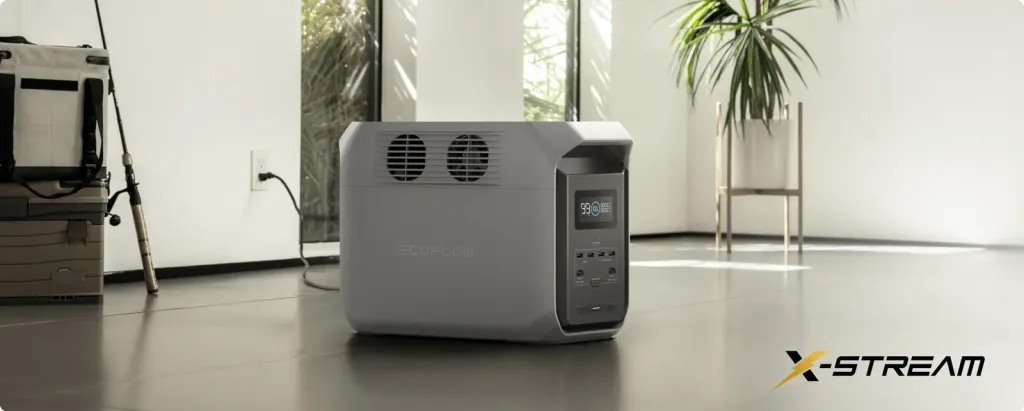
Side-by-Side Specification Comparison
| Specification | Jackery Explorer 2000 v2 | EcoFlow DELTA 3 Plus |
|---|---|---|
| Internal Capacity (LFP) | 2,042Wh | 1,024Wh |
| Expandable Max Capacity | Not expandable | Up to 5,120Wh (DELTA 3 / 2 Max / Pro 3 packs) |
| Weight & Carry Ergonomics | 39.5 lbs (13.2 × 10.4 × 11.5 in) |
27.6 lbs (15.7 × 8.3 × 11.2 in) |
| Continuous / Surge AC | 2,200W / 4,400W | 1,800W / 3,600W (+ X-Boost resistive) |
| AC Wall Outlets | 3 × 120V NEMA 5-20R | 6 × 120V NEMA 5-20R/5-15R |
| USB-C PD / USB-A Ports | 1 × 100W + 1 × 30W USB-C; 1 × 18W USB-A | 2 × 140W USB-C PD 3.1; 2 × 36W USB-A |
| Solar Input & MPPT Spec | 400W max (16–60V Voc, dual DC8020) |
1,000W max (Dual 500W MPPT, 11–60V, XT60i) |
| AC Charging Speed | 1,800W (~1.7h Emergency; ~2.5h OutdoorGearLab test) |
1,500W (~56 mins 0–100%) |
| Alternator Charging Ecosystem | Standard 12V car port (~100W–120W) |
Supports optional 800W Alternator Charger |
| UPS / EPS Transfer Time | <=20 ms EPS |
<10 ms UPS + USB HID PC/NAS signal |
| Cycle Life Rating | 4,000 cycles to >=70% | 4,000 cycles to 80% |
| US Warranty & Street Price | 5 yrs (3+2 reg) / ~$999 typical | 5 yrs direct / ~$699 typical (base unit) |
Weight & Capacity Engineering: Why 39.5 lbs Changes the 2kWh Market
Traditionally, carrying 2,000Wh of LiFePO4 cells meant hauling 60+ pounds (for comparison, Jackery’s expandable Explorer 2000 Plus weighs 61.5 lbs and the BLUETTI AC200L weighs 62.4 lbs). By switching to a Cell-to-Body (CTB) structural frame, Jackery shaved roughly 22 pounds off the 2,042Wh Explorer 2000 v2—putting it within easy reach of apartment dwellers, RV travelers without lift gates, and solo campers loading SUV trunks.
Independent testing backs up Jackery’s physical usability claims:
- OutdoorGearLab awarded top portability marks in the 2kWh class and measured an average ~2.5-hour 0–100% AC wall recharge (
~817 Wh/hr), praising its single-unit camping practicality while explicitly calling out the lack of battery expansion and need for panel adapters. - TechRadar (
4.5/5hands-on rating) confirmed reliable blackout performance across kitchen appliances (2,200Wcontinuous /4,400Wsurge handles coffee makers, microwaves, and residential refrigerators effortlessly) alongside whisper-quiet~30 dBindoor charging, while similarly identifying the 400W solar cap as its main off-grid constraint.
Realistic Single-Charge Energy Math (78%–88% AC / 88%–93% DC)
Assuming standard 78%–88% AC inverter delivery (or 88%–93% DC/USB-C when bypassing the AC inverter):
- Jackery Explorer 2000 v2 delivers roughly 1,593–1,797 Wh out of its AC plugs—enough to carry an average cycling kitchen refrigerator (
~50–65Waverage draw plus inverter standby) for roughly 24–32 hours on a pre-storm grid charge without touching a solar panel. - EcoFlow DELTA 3 Plus (unexpanded
1,024Wh) delivers roughly 799–901 Wh AC—closer to 12–16 hours on that same refrigerator before needing a recharge or an extra battery.
If your primary outage problem is a 12-to-24-hour overcast storm or single-weekend trip where you pre-charge from a wall outlet beforehand, double the onboard capacity at 39.5 lbs gives the Jackery Explorer 2000 v2 an unmistakable edge.
Solar Recovery & Road Recharging: 1,000W Dual MPPT vs. 400W DC8020
Flip the scenario to a sunny 4-day off-grid camp or multi-day post-hurricane outage without grid power, and the numbers swing sharply toward EcoFlow.
Under real outdoor sunlight, NREL solar irradiance benchmarks remind buyers that portable panels rarely hit 100% of Standard Test Conditions (STC) label wattage due to cell heat, sun angle, and cable/controller loss—typically yielding 60%–75% of rated watts during midday hours:
- Jackery Explorer 2000 v2 (
400WCap): Two 200W panels (400WSTC total) plugged into Jackery’s dualDC8020ports (16V–60VVoc) typically harvest ~240W–300W in clear midday sun. Recovering1,800 Whused over 24 hours requires 6 to 8+ peak sun hours—meaning one partly cloudy afternoon leaves you sliding into an energy deficit. Generic third-party MC4 solar panels also requireDC8020adapter cables. - EcoFlow DELTA 3 Plus (
1,000WDual MPPT): EcoFlow equips the DELTA 3 Plus with two independent 500W MPPT ports (11V–60V,15Aper XT60i port). Pairing 800W–1,000W of portable solar panels typically yields 600W–750W+ real charging, refilling the1,024Whpack in ~1.4 to 1.8 hours of clean sun—and recovering a full overnight fridge draw before lunchtime. Just confirm your panel strings stay strictly below 60V Voc in cold weather.
Add EcoFlow’s optional 800W Alternator Charger (replenishing 1,024Wh in roughly 1.3 hours of highway driving versus ~15–20 hours on Jackery’s ~100W 12V socket), and the DELTA 3 Plus behaves like an active off-grid energy engine rather than a static bucket.
Office UPS, Outlet Density & Expandability
Look closely at the front panels and rear ports, and three functional differences separate daily usability:
<10 msHID UPS vs.<=20 msEPS: Standard desktop PC ATX power supplies typically target16–17 mscapacitor hold-up time at high load. Jackery’s<=20 msEPS rating protects refrigerators, routers, and TVs well, but can allow heavy desktop rigs or RAID NAS boxes to reboot during grid drop. EcoFlow DELTA 3 Plus specifies<10 msswitchover plus a USB HID port, signaling compatible PCs or NAS units to save files and shut down gracefully during long blackouts. Check our UPS vs. EPS Switching Guide for details.- Ports & Simultaneous Charging: EcoFlow includes 6 AC outlets and dual 140W USB-C PD 3.1 ports (ideal for power-hungry workstations and dual MacBook Pros without AC power bricks), versus 3 AC outlets and
100W + 30WUSB-C on Jackery. - Scaling Later: Should your energy appetite double next year, adding a compatible Smart Extra Battery expands the DELTA 3 Plus up to 5,120Wh—even though stacking an inverter plus battery raises carry weight past Jackery’s single-box
39.5 lbs.
Which Outage Problem Are You Buying For?
- Choose the Jackery Explorer 2000 v2 (
~$999) if: You want maximum single-unit2kWhruntime in a remarkably light 39.5 lb carry frame, need native 2,200W / 4,400W surge headroom for kitchen appliances or fridge startups, expect to pre-charge primarily from wall outlets (~1.7–2.5 hrs), and prefer simple non-modular storage for single-day storms or weekend camping. - Choose the EcoFlow DELTA 3 Plus (
~$699) if: You work from home and want<10 msHID UPS protection, rely on fast1,000Wdual-MPPT solar or 800W alternator recovery over multi-day off-grid trips, want 6 AC + dual 140W USB-C ports at27.6 lbs, or want the freedom to expand up to5kWhlater.
Compare both units alongside BLUETTI and Anker peers in our Power Station Finder, calculate exact panel recharge windows in the Solar Charging Calculator, or see how Jackery stacks up against a heavier 2kWh solar workhorse in BLUETTI AC200L vs. Jackery Explorer 2000 v2.

Models Discussed in This Article
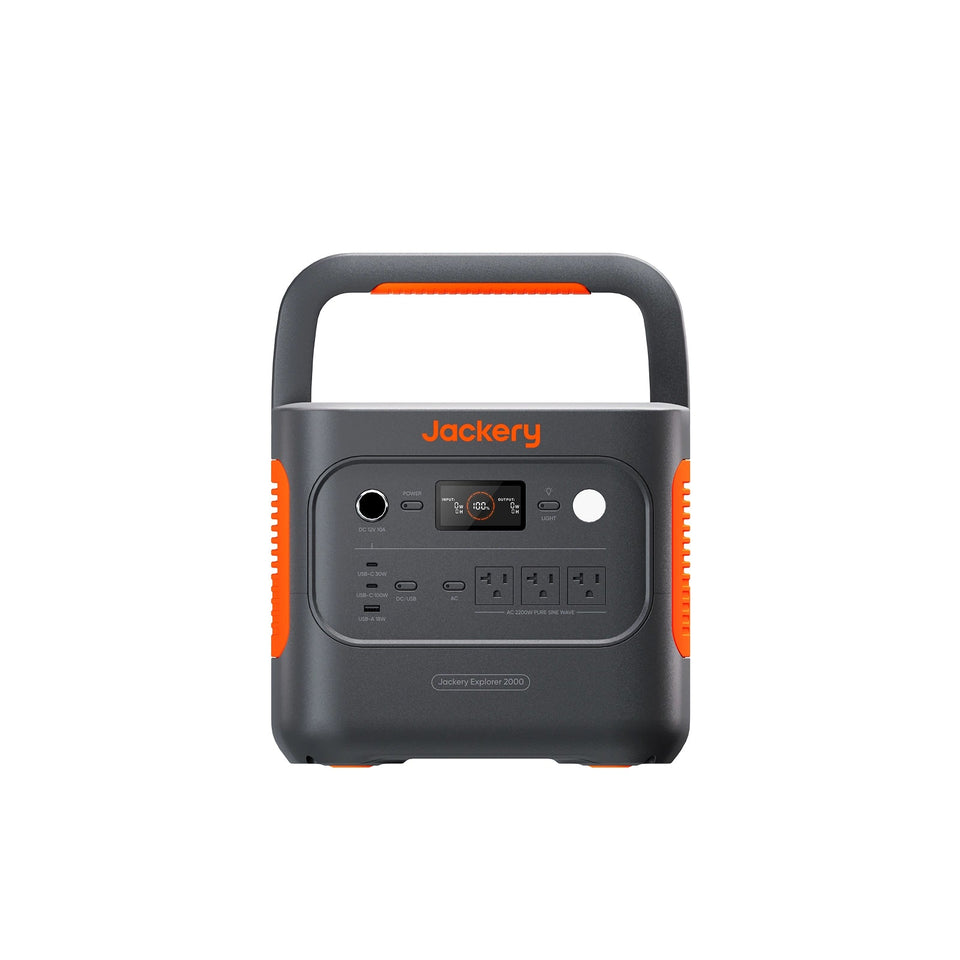
Jackery Explorer 2000 v2
A breakthrough 39.5 lb chassis makes 2,042Wh genuinely single-hand portable for camping and apartments, provided you accept its 400W solar recharge ceiling and non-expandable battery.
EcoFlow DELTA 3 Plus
Packs 1,000W dual-MPPT solar charging, sub-1-hour AC replenishment, and a sub-10 ms HID-capable UPS into a 27.6 lb chassis, making it more versatile than non-Plus 1kWh units.
Frequently Asked Questions
Can the Jackery Explorer 2000 v2 add extra battery packs like the EcoFlow DELTA 3 Plus?+
No. Jackery built the Explorer 2000 v2 using a sealed Cell-to-Body (CTB) chassis that achieves an impressive 39.5 lb carry weight by omitting expansion ports entirely. If you need expandable capacity in Jackery's catalog, look at the Explorer 2000 Plus (61.5 lbs) or 5000 Plus, whereas EcoFlow DELTA 3 Plus scales from 1,024Wh up to 5,120Wh via Smart Extra Batteries.
How long does it actually take to solar-charge the Jackery Explorer 2000 v2 compared to the DELTA 3 Plus?+
Because outdoor solar panels typically produce 60%–75% of nameplate STC watts per NREL irradiance realities, Jackery's 400W solar ceiling yields ~240–300W real input—requiring roughly 7 to 9+ peak sun hours to fill 2,042Wh from empty. EcoFlow DELTA 3 Plus accepts up to 1,000W across dual 500W MPPT ports, recovering 1,024Wh in under 1.5–2 hours of strong sunlight.
Will the Jackery Explorer 2000 v2 safely keep a desktop gaming PC or NAS online during a blackout?+
Not reliably on every unit. Jackery rates the Explorer 2000 v2 for <=20 ms EPS switchover, which meets refrigerator and lighting needs but approaches or exceeds standard 16–17 ms ATX power supply hold-up thresholds under heavy load. EcoFlow DELTA 3 Plus specifies <10 ms switchover plus USB HID communication for graceful PC and NAS shutdowns.
Which unit powers a full-size refrigerator longer on a single charge without solar panels?+
The Jackery Explorer 2000 v2 wins on unassisted single-charge runtime because its 2,042Wh pack stores roughly double the EcoFlow DELTA 3 Plus's 1,024Wh base battery. At an estimated 78%–88% AC efficiency (~1,593–1,797 Wh usable vs. ~799–901 Wh), the Jackery typically carries a modern refrigerator roughly 24–32 hours versus ~12–16 hours on an unexpanded DELTA 3 Plus.
Sources & Technical References
- View Source →[1]Manufacturer SpecificationJackery US OfficialVerified 2026-11-24Jackery Explorer 2000 v2 Product Page & User Guide
2,042Wh LFP Cell-to-Body design, 39.5 lbs weight, 2,200W continuous AC, 400W dual DC8020 solar input.
- View Source →[2]Third-Party Independent ReviewOutdoorGearLabVerified 2026-11-24Jackery Explorer 2000 v2 Independent Review & Benchmark Testing
Reports ~2.5 hour full AC recharge (~817 Wh/hr average), high portability score for 2kWh class, and solar expansion trade-offs.
- View Source →[3]Third-Party Independent ReviewTechRadarVerified 2026-11-24Jackery Explorer 2000 v2 Hands-On Review
Evaluates kitchen appliance support, Cell-to-Body weight reduction (39.5 lbs), quiet charging profile, and 400W solar ceiling.
- View Source →[4]Manufacturer SpecificationEcoFlow US OfficialVerified 2026-11-24EcoFlow DELTA 3 Plus Official Specifications
1,024Wh LFP, 1,800W continuous AC, 1,000W dual 500W MPPT solar, <10ms UPS, 1,500W X-Stream AC charging.
- View Source →[5]Government Research ResourceNational Renewable Energy Laboratory (NREL)Verified 2026-11-24PVWatts & US Peak Sun Hours Reference Data
Documents regional peak sun hours and real-world photovoltaic derating factors (ambient heat, angle, shading, controller loss).