How Long Can a Portable Power Station Run a Refrigerator? Duty Cycle & Runtime Guide
Why refrigerator backup runtime depends on compressor duty cycles and inverter idle draw—with CNET benchmark comparisons and sizing ranges from 1kWh to 6kWh+.
A typical modern US kitchen refrigerator draws around 150W when its compressor runs (with ~600W startup surge), but cycles on only ~30%–45% of the day—consuming roughly 1,200–1,800 Wh/day. A high-efficiency 2,048Wh unit like the BLUETTI AC200L exceeded 29 hours in CNET's standardized fridge test, whereas a 1,024Wh unit typically provides ~10–16 hours and multi-day outages require solar or expandable capacity.

Keeping food and medications safely chilled is usually the #1 reason homeowners buy a portable power station. Yet predicting refrigerator runtime trips up more buyers than almost any other appliance because refrigerators do not behave like steady light bulbs.
Compressor Duty Cycles vs. Nameplate Labels
If you pull out a standard modern kitchen refrigerator and read its label, it might say 120V / 6.5A (780W maximum defrost/peak nameplate). In normal kitchen operation:
- Steady Compressor Draw: Usually 120W to 180W (~150W typical baseline).
- Brief Startup Surge: Roughly 500W to 800W (~600W typical; modern variable-speed inverter fridges surge much lower than legacy single-speed compressors).
- Compressor Duty Cycle: The compressor typically cycles active roughly 30% to 45% of the day in a 70°F kitchen—meaning actual fridge consumption is usually 1.2 kWh to 1.8 kWh (1,200–1,800 Wh) per 24 hours, not
150W × 24h = 3,600 Wh.
Why Inverter Standby Draw Rules 24-Hour Fridge Tests
Because the refrigerator’s thermostat stays waiting for the compressor to call for cooling, your power station’s AC inverter must remain turned ON for the entire 24 hours—even during the 14–16 hours when the compressor is asleep.
That explains CNET Labs’ eye-opening benchmark comparison:
- The 2,048Wh 120V BLUETTI AC200L delivered >29 hours on CNET’s standardized refrigerator test (
77.76%round-trip efficiency). - The 3,840Wh 120V/240V Anker SOLIX F3800—despite packing nearly 88% more rated battery capacity—ran roughly 25.68 hours on the same test because its big 6,000W dual-voltage inverter consumes far more standby energy every hour the unit sits awake.
Estimated Refrigerator Runtime by Power Station Tier
Assuming an average refrigerator consuming ~1.4–1.7 kWh/day (about 60–70W true 24-hour average before inverter overhead):
| Model & Tier | Rated Capacity | Continuous AC | Realistic Refrigerator Outlook (24h Cycling) |
|---|---|---|---|
| Anker SOLIX C300 | 288 Wh | 300 W | Not Suitable — inverter output too small for reliable compressor startup & short runtime. |
| EcoFlow DELTA 3 Plus | 1,024 Wh | 1,800 W | Short Bridge (~10–15 hrs est.) — easily starts compressor; pairs well with 1,000W solar for daytime recovery. |
| BLUETTI AC200L | 2,048 Wh | 2,400 W | Verified >29 hrs (CNET test) — standout single-unit 2kWh efficiency; expandable up to 8,192Wh. |
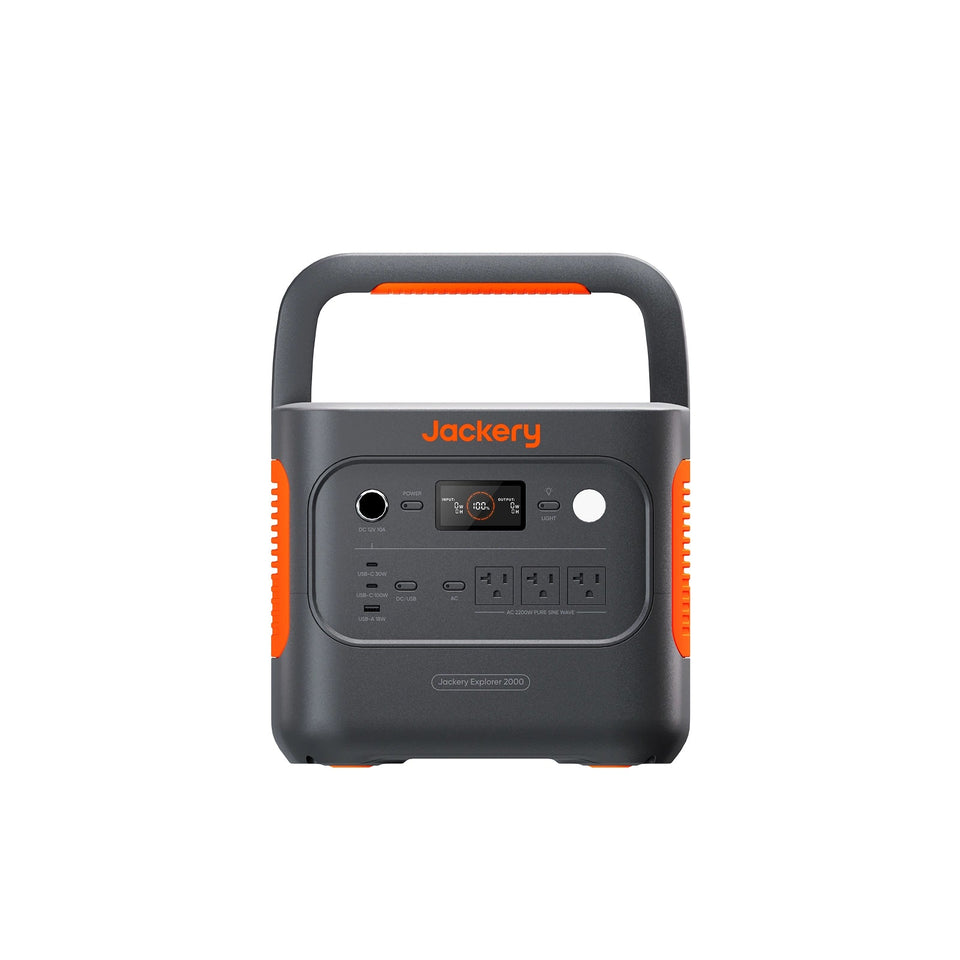
| Jackery Explorer 2000 v2 | 2,042 Wh | 2,200 W | ~22–30 hrs est. (unverified usable AC in our registry) — strong portability at 39.5 lbs; 400W solar ceiling. |
| EcoFlow DELTA Pro Ultra | 6,144 Wh | 7,200 W | Multi-Day (~2–3.5 days est. per 6kWh block) — note 240V inverter overhead eats more % if fridge is the only load. |
Practical Outage Tips to Stretch Fridge Backup Time
- Keep Doors Closed & Pre-Chill Before Storms: A full, unopened refrigerator holds safe food temperatures (~40°F or below) for roughly 4 hours even without power, and a full freezer holds ~48 hours. Pre-freeze water bottles before hurricanes or ice storms to reduce compressor duty cycles.
- Disable Automatic Ice Makers & Turn Off Heated Dispenser Mullion Strips (If Possible): Automatic defrost heaters and ice-maker harvest heaters draw 300W–600W spikes intermittently; minimizing door humidity reduces defrost cycles.
- Pair 2kWh Capacity With Solar Recovery: If outage duration exceeds 24 hours, plan at least 600W–1,200W of solar input headroom (like the BLUETTI AC200L’s 1,200W or EcoFlow DELTA 3 Plus’s 1,000W inputs) rather than relying solely on stored battery capacity.
Calculate your fridge alongside routers, lights, and CPAP units in our Appliance Wattage Calculator or model exact runtime ranges in the Runtime Calculator.
Models Discussed in This Article
BLUETTI AC200L
Combines a high-efficiency 2,048Wh expandable platform, 1,200W high-voltage solar input (12–145V), and dedicated 30A TT-30R + 48V DC RV outputs at strong street pricing, trading away light weight and built-in wheels.
Jackery Explorer 2000 v2
A breakthrough 39.5 lb chassis makes 2,042Wh genuinely single-hand portable for camping and apartments, provided you accept its 400W solar recharge ceiling and non-expandable battery.

Anker SOLIX F3800
One of the most approachable plug-and-play 120V/240V wheeled units thanks to built-in NEMA 14-50R and L14-30R ports, though high idle overhead on light loads and the 60V solar cap (on the original non-Plus SKU) require careful sizing.

EcoFlow DELTA Pro Ultra
Built specifically for homeowners seeking high-voltage solar input (up to 5,600W) and modular 6kWh-per-stack scaling, though total kit cost and modular footprint exceed casual portable needs.
Frequently Asked Questions
Can a 300W or 500W portable power station run a full-size kitchen refrigerator?+
Usually not reliably. While a refrigerator compressor may settle around 120W–180W while running, its brief startup surge typically reaches 600W+ (and older non-inverter fridges or automatic defrost heating cycles can push higher). A 300W station like the Anker SOLIX C300 is unsuitable for full-size refrigerators; target at least 1,000W–1,800W+ continuous AC output.
Should I unplug my refrigerator between cooling cycles to save battery?+
Manually cycling a fridge off and on is risky unless you monitor food temperatures closely with a fridge thermometer, because compressor timing varies with room temperature and door openings. Keeping the fridge closed and choosing a 120V power station with low inverter idle draw is safer and far easier.
Sources & Technical References
- View Source →[1]Third-Party Independent ReviewCNETVerified 2026-11-24CNET Portable Power Station Lab Efficiency & Refrigerator Runtime Benchmarks
Documents standardized refrigerator runtime and round-trip efficiency testing including BLUETTI AC200L (77.76% RTE, >29h fridge test) and Anker SOLIX F3800 (~25.68h fridge stress runtime due to dual-voltage inverter overhead).
- View Source →[2]Manufacturer SpecificationBLUETTI US OfficialVerified 2026-11-24BLUETTI AC200L Portable Power Station Official Specifications
2,048Wh LFP, 2,400W continuous AC, 3,600W Power Lifting mode, NEMA TT-30R + 48V/8A DC RV port, 1,200W solar (12-145V).
- View Source →[3]Manufacturer SpecificationAnker SOLIX US OfficialVerified 2026-11-24Anker SOLIX F3800 Portable Power Station Official Specifications
North American model specs including NEMA 14-50R, L14-30R, 6,000W output, 3,840Wh capacity, and 11-60V dual solar input.
- View Source →[4]Manufacturer SpecificationJackery US OfficialVerified 2026-11-24Jackery Explorer 2000 v2 Product Page & User Guide
2,042Wh LFP Cell-to-Body design, 39.5 lbs weight, 2,200W continuous AC, 400W dual DC8020 solar input.
- View Source →[5]Manufacturer SpecificationEcoFlow US OfficialVerified 2026-11-24EcoFlow DELTA Pro Ultra Product Page & Specifications
Official North American 120V/240V split-phase inverter and 6,144Wh LiFePO4 battery module specs.