Anker SOLIX C300 Review (2026): Ultralight 288Wh Vertical Tower & Model A1722 Notes
Anker SOLIX C300 (A1722) US review: 288Wh LFP at 9.1 lbs, 300W AC, dual 140W USB-C, <10ms UPS, 100W solar cap, and C300 AC vs C300 DC buying notes.
Weighing just 9.1 lbs in an upright 6.5 × 6.3-inch footprint, the Anker SOLIX C300 (AC-equipped Model A1722) delivers 288Wh of LiFePO4 storage, 300W pure-sine AC, dual 140W bidirectional USB-C ports, Wi-Fi/Bluetooth app telemetry, and a <10 ms UPS for routers and laptops near $229 street price. Buyers must double-check SKU Model A1722 to avoid accidentally ordering the AC-less C300 DC variant, and recognize that 288Wh and 300W AC cannot sustain full-size refrigerators or heating appliances.
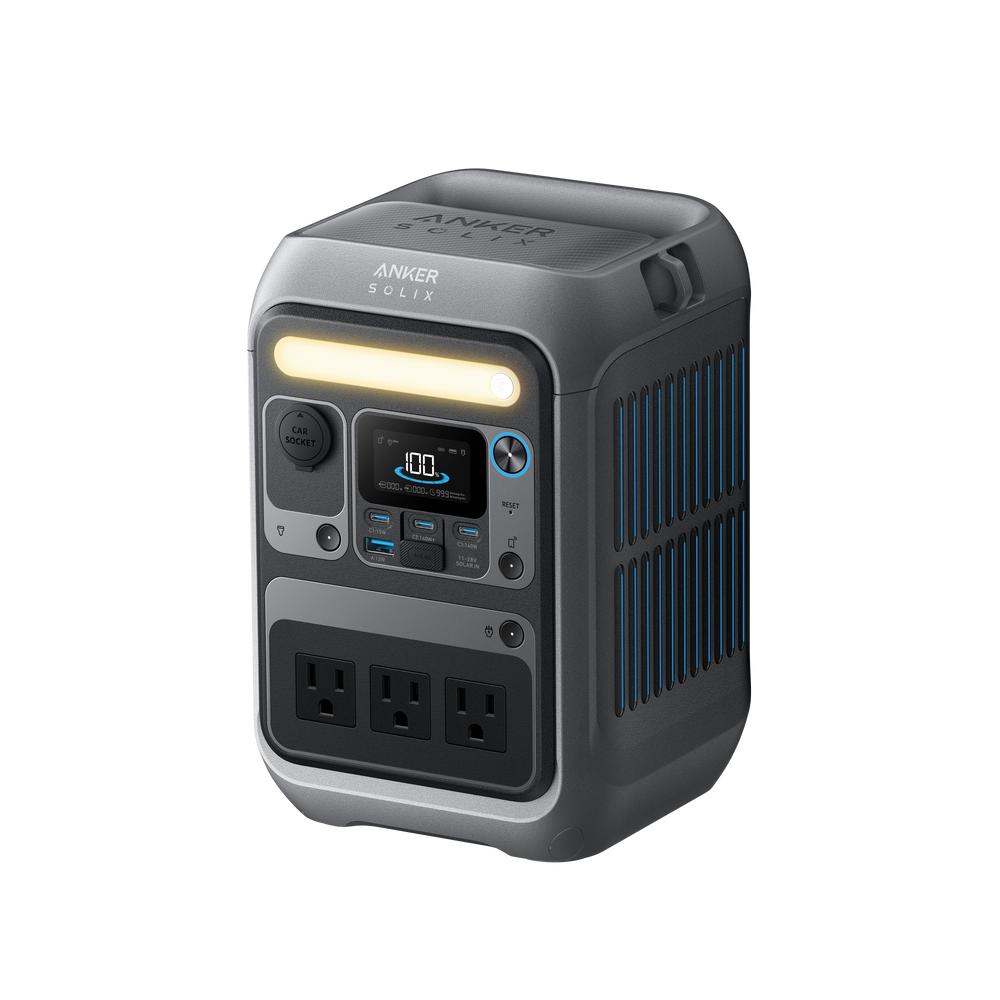
Standard list $249.99–$329.99; frequently discounted between $189 and $249 in US promotions ($0.80/rated Wh at street pricing).
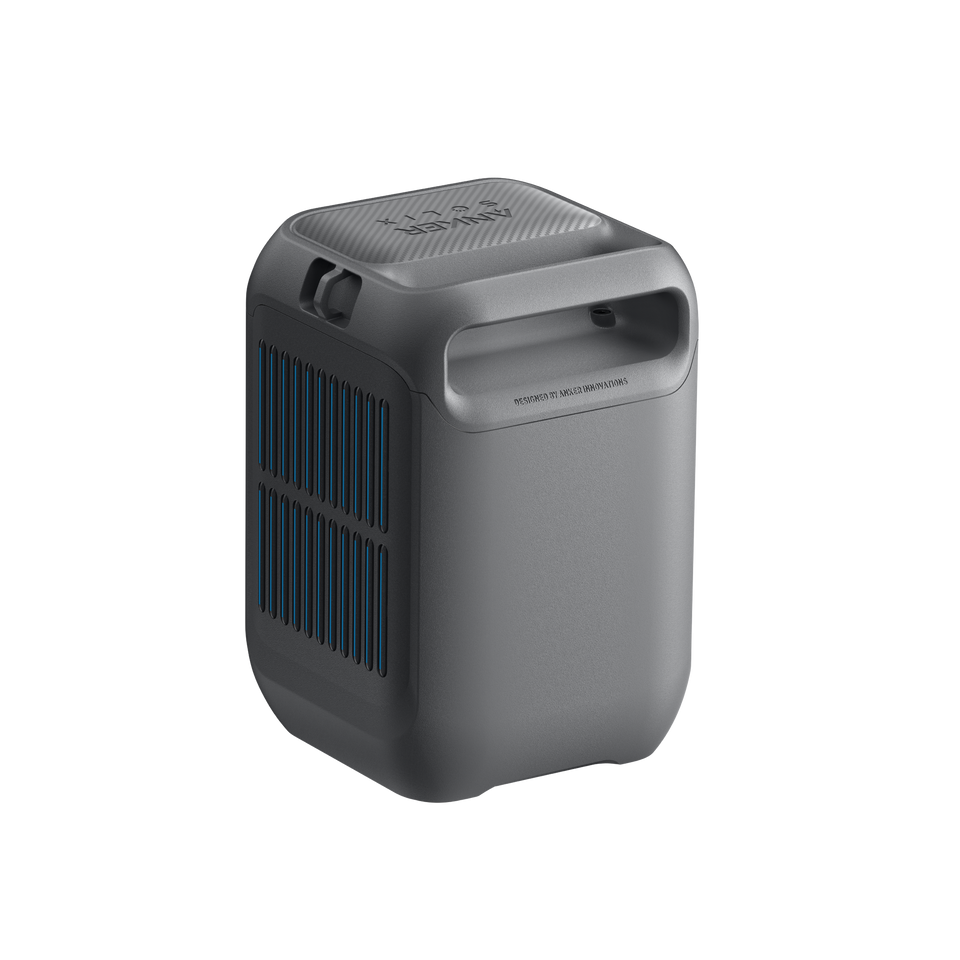
Official Hardware & Application Gallery
Sourced from Anker SOLIX official product media 
Key Advantages
- ✓Ultra-compact 9.1 lb vertical footprint saves floor and pack space
- ✓Dual 140W bidirectional USB-C ports charge modern laptops without bulky AC adapters
- ✓<10 ms UPS switchover protects home Wi-Fi routers and fiber ONTs at an entry-level price
Trade-offs & Limitations
- !288Wh capacity and 300W continuous inverter limit use to electronics, LED lighting, and small fans
- !100W solar ceiling and 28V Voc limit prevent connecting high-voltage rigid panels
- !Must verify SKU A1722 (with AC outlets) vs the cheaper AC-less C300 DC variant
Ideal Applications
- Emergency Wi-Fi/modem UPS, phone/laptop charging, CPAP travel (DC), and day camping
- Renters and students wanting affordable LFP backup under $250
Situations Where It May Not Fit
- Full-size refrigerators, microwaves, coffee makers, or multi-day blackout survival
- High-wattage solar charging above 100W
Complete Verified Specifications
| Specification | Verified Data | Data Provenance |
|---|---|---|
| Product Name & Revision | Anker SOLIX C300 (C300 AC-Equipped Model A1722 (distinct from DC-only C300 DC)) | Manufacturer Spec |
| US Market Version | US 120V Edition (Model A1722) | Manufacturer Spec |
| Battery Capacity (Rated) | 288 Wh | Manufacturer Spec |
| Measured Usable AC Output | Not Independently Verified | Unverified |
| Battery Chemistry | LiFePO4 (LFP) | Manufacturer Spec |
| Published Cycle Life | 3,000+ cycles to 80% capacity — Manufacturer specification under standard 25°C cycling | Manufacturer Spec |
| Continuous AC Output | 300 W (600W SurgePad handles select resistive heating loads above 300W (not for motor loads above 300W continuous)) | Manufacturer Spec |
| Published Surge Output | 600 W | Manufacturer Spec |
| Published Surge Duration | Not Disclosed (SurgePad rating) | Not Disclosed |
| AC Output Voltage | 120V | Manufacturer Spec |
| AC Outlet Types | 3 × 120V standard AC outlets | Manufacturer Spec |
| USB-A Output | 1 × USB-A (12W max) | Manufacturer Spec |
| USB-C Output | 3 × USB-C (2 × 140W bidirectional PD + 1 × 15W) | Manufacturer Spec |
| DC Output Ports | 1 × 12V/10A Car Port (120W max) | Manufacturer Spec |
| Max Solar Input | 100 W | Manufacturer Spec |
| Solar Input Voltage Range (Voc) | 11V–28V Voc (XT60 port) | Manufacturer Spec |
| Solar Input Current Limit | 8.2A max | Manufacturer Spec |
| MPPT Configuration | Built-in MPPT solar controller (100W max via XT60) | Manufacturer Spec |
| AC Charging Rate | 330 W max — Up to 330W AC HyperFlash charging (0–80% in ~50 mins; full ~68 mins) or up to 280W dual USB-C input | Manufacturer Spec |
| Car / Alternator Charging | Up to 100W via car socket | Manufacturer Spec |
| Published Recharge Time | ~68 mins via 330W AC; ~3.5+ hrs via peak 100W solar panel | Mfr / Attributed Test |
| Expandable Capacity | Not Applicable — ultra-compact standalone travel unit | Manufacturer Spec |
| Supported Expansion Batteries | Not Applicable | Manufacturer Spec |
| UPS / EPS Functionality | Fast automatic UPS backup switchover | Manufacturer Spec |
| Published Switching Time | <10 ms (manufacturer rated) | Manufacturer Spec |
| Weight | 9.1 lbs (Approx. 4.13 kg vertical tower footprint with optional shoulder-strap attachment) | Manufacturer Spec |
| Dimensions (L × W × H) | 6.5 × 6.3 × 9.5 in | Manufacturer Spec |
| Operating Temp (Charging) | 32°F to 104°F (0°C to 40°C) | Manufacturer Spec |
| Operating Temp (Discharging) | -4°F to 104°F (-20°C to 40°C) | Manufacturer Spec |
| Noise Rating (Manufacturer) | ~25 dB (manufacturer rated ultra-quiet operation) | Manufacturer Spec |
| App & Connectivity | Wi-Fi & Bluetooth via Anker App | Manufacturer Spec |
| Warranty & Verification Date | 5-Year Hassle-Free Warranty (Verified 2026-11-24) | Manufacturer Policy |
| Pricing & Value per Rated Wh | Typical Street ~$229 ($0.80/rated Wh) | MSRP $329.99 ($1.15/rated Wh) | Checked 2026-11-24 |
Evidence & Data Provenance Breakdown
SolarGeneratorWholeHouse separates official specifications, third-party measurements, owner patterns, and editorial estimates.
Capacity (288Wh LiFePO4 (LFP)), continuous AC (300W), surge (600W), solar voltage limits (11V–28V Voc (XT60 port)), and warranty (5-Year Hassle-Free Warranty) are sourced directly from Anker SOLIX documentation.
Not Independently Verified in Our Source Registry: Independent laboratory usable-AC-Wh discharge benchmarks for this exact US SKU are not yet recorded in our verified registry; runtime figures below use clearly labeled engineering estimates.
Noise (~25 dB (manufacturer rated ultra-quiet operation)) and cycle retention (3,000+ cycles to 80% capacity) reflect Anker SOLIX's published ratings under manufacturer-specified test temperatures rather than independent long-term wear tests.
Buyers love the small footprint, dual 140W USB-C speed, and low street price, while reminding newcomers to confirm they are buying the AC-outlet C300 rather than the C300 DC.
Unpublished fields: Surge duration (Not Disclosed (SurgePad rating)).
Estimated AC Runtime Scenarios
| Sample Load | Estimated Runtime Range | Calculation Basis |
|---|---|---|
| Wi-Fi Router & Modem (~25W AC) | 9–10.1 hrs | Estimated 78%–88% usable AC range (untested model; accounts for inverter conversion & idle draw) |
| CPAP Machine (~45W AC avg) | 5–5.6 hrs | Estimated 78%–88% usable AC range (untested model; accounts for inverter conversion & idle draw) |
| Modern Refrigerator Avg Draw (~150W) | 1.5–1.7 hrs | Estimated 78%–88% usable AC range (untested model; accounts for inverter conversion & idle draw) |
| Home Office / Mixed Essential Load (~400W) | 0.6–0.6 hrs | Estimated 78%–88% usable AC range (untested model; accounts for inverter conversion & idle draw) |
Overview & US Market Positioning
The Anker SOLIX C300 (US 120V AC-Equipped Edition, Model A1722) proves that modern LiFePO4 safety, fast USB-C Power Delivery, and sub-10 ms UPS backup no longer require hauling a 25 lb brick. Shaped like a compact upright lantern tower (9.1 lbs with an optional shoulder-strap mount), it sits at the entry point of our verified catalog—routinely selling around $229 typical street price ($189–$249 promotions).
One critical shopping warning applies before clicking buy: Anker sells two visually similar models under the C300 banner. The C300 (Model A1722) reviewed here includes three 120V AC outlets and a 300W pure-sine inverter. Its sibling, the C300 DC, eliminates AC outlets and the AC inverter completely in favor of pure USB/DC output. Always verify Model A1722 (AC outlets visible on the chassis) if you need standard wall plugs for routers, fans, or CPAP AC adapters.
Battery Capacity, Chemistry & Cycle Longevity
Despite its compact travel footprint, the C300 avoids older 500-cycle NMC cells and integrates 288Wh of LiFePO4 (LFP) chemistry rated for 3,000+ cycles to 80% capacity under standard 25°C cycling. For students, renters, or travelers keeping it plugged in continuously as an apartment router UPS or tossing it into a day-trip pack, LFP durability ensures many years of service.
Thermal ratings cover 32°F to 104°F (0°C to 40°C) for charging and -4°F to 104°F (-20°C to 40°C) for discharging. Keep in mind that sub-freezing recharging is blocked without warming the unit indoors above 32°F first.
Continuous AC Output, Surge Behavior & Voltage Support
The 120V pure sine wave inverter outputs 300W continuous, paired with 600W SurgePad support (exact published surge duration is Not Disclosed). Like BLUETTI’s Power Lifting, 600W SurgePad reduces voltage solely to sustain select resistive heating loads above 300W—it will not start inductive motors or compressors requiring more than 300W continuous. Keep expectations realistic: 300W AC handles routers, fiber ONTs, CPAP machines (with heated tube/humidifier reduced or off), small fans, camera chargers, and laptops, while excluding coffee makers, hair dryers, air fryers, and full-size refrigerators.
Where the C300 punches far above older 300Wh stations is its modern USB-C DC layout:
- 3 × 120V standard AC outlets
- 3 × USB-C ports, including two 140W bidirectional USB-C PD ports + one 15W USB-C
- 1 × 12W USB-A port
- 1 × 12V/10A car socket (120W max)
Having two 140W USB-C ports lets two MacBook Pros or portable monitors fast-charge natively over DC without ever waking the 300W AC inverter—saving conversion energy and extending effective runtime dramatically.
Solar Charging, AC Charging & Expansion Ecosystem
Compact size brings clear solar and expansion limits. Its single XT60 MPPT port tops out at 100W max solar with a tight 11V to 28V Voc voltage window and 8.2A max current limit. That strictly limits solar pairing to single portable 12V-nominal panels (like a 100W folding panel whose Voc sits around 21V–24V); connecting higher-voltage residential panels or series strings over 28V Voc risks damaging the controller. Expect 3.5+ hours for a solar recharge under peak sunlight (use our Solar Charging Time Estimator for regional estimates).
Wall and USB-C charging, conversely, are impressively nimble: 330W AC HyperFlash charging hits 0–80% in ~50 minutes and 100% in ~68 minutes, or you can recharge directly via up to 280W dual USB-C input (and up to 100W from a 12V car socket). As a standalone ultralight travel station, the C300 is non-expandable.
UPS/EPS Behavior, Cooling Noise & App Features
At $229 street price, two features stand out as genuinely uncommon in the <300Wh class:
- <10 ms Automatic UPS Switchover: Keeps home Wi-Fi routers, cable/fiber gateways, and laptops online seamlessly during flickers—beating many pricier 700Wh–2kWh stations rated at <=20 ms. (See our UPS and EPS switching guide.)
- Wi-Fi + Bluetooth App Control: Full remote monitoring via the Anker App alongside a manufacturer-rated ~25 dB ultra-quiet acoustic rating—making bedside CPAP or home-office desk placement unobtrusive. (Note that independent lab dB verification is not recorded in our registry.)
Runtime Considerations & Real-World Performance Data
Independent third-party laboratory usable AC watt-hour tests and standardized round-trip efficiency figures for the Anker SOLIX C300 are Not Independently Verified in our source registry. Using our standard 78% to 88% AC conversion range on 288Wh (225Wh to 253Wh estimated usable AC output):
- Wi-Fi Router & Modem (~25W AC): Approx. 9.0 to 10.1 hours (enough to bridge typical evening outages without dropping work calls).
- CPAP Machine (~45W AC): Approx. 5.0 to 5.6 hours via AC (roughly one partial night; turning off humidification or powering via DC extends runtime significantly toward a full night).
- 150W AC Load: Approx. 1.5 to 1.7 hours (suitable only for short bursts on laptops/TVs—not multi-day refrigerator preservation).
- (Note: Loads above 300W continuous exceed the pure-sine AC ceiling; SurgePad up to 600W applies solely to compatible resistive elements.)
For charging phones, tablets, drones, and USB-C laptops directly over DC, you bypass AC inverter overhead completely—capturing closer to 88%–92% of the 288Wh pack. Check custom combinations in our Battery Runtime Estimator.
Build Quality, Portability & Dimensions
Weighing just 9.1 lbs (4.13 kg) and standing 6.5 × 6.3 × 9.5 inches, the vertical tower footprint occupies barely half the desk or closet floor area of horizontal 300Wh stations. Combined with an optional shoulder-strap attachment and recessed handle, it packs as easily as a small DSLR camera bag—and unlike 20–40 lb stations, teenagers or travelers can carry it effortlessly on day hikes, beach picnics, or road trips.
Advantages, Disadvantages & Ideal Applications
Key Advantages
- Ultralight 9.1 lb vertical footprint saves serious desk, tent, and trunk space.
- Dual 140W bidirectional USB-C ports plus 330W HyperFlash AC charging (~68 mins full).
- <10 ms UPS switchover, ~25 dB rated acoustics, and Wi-Fi + Bluetooth app control around $229 street pricing.
Trade-offs & Limitations
- 288Wh capacity and 300W continuous AC inverter rule out refrigerators, microwaves, coffee makers, and extended blackouts.
- 100W / 28V Voc solar limit prevents pairing high-voltage panels or faster >100W solar arrays.
- Buyers must confirm Model A1722 (with AC outlets) vs. the AC-less C300 DC; independent usable AC Wh data is Not Independently Verified.
Ideal Applications: Emergency Wi-Fi router/modem UPS backup, remote-work laptop and phone charging, weekend tent camping, and students or apartment renters wanting affordable LFP preparedness under $250. Buyers needing refrigerator protection or 1,000W appliance support should step up to the BLUETTI AC70 or EcoFlow DELTA 3 Plus.
Price, Value per Rated Wh & Warranty
Listing at $249.99–$329.99 ($1.15/rated Wh at $329.99 MSRP) and trading regularly between $189 and $249—averaging $229 street price—the Anker SOLIX C300 sits at $0.80 per rated Wh ($0.66/Wh during $189 sales). While small capacities naturally carry a higher $/Wh than 1,500Wh–5,000Wh stations due to fixed inverter, BMS, and enclosure overhead, getting a 3,000-cycle LFP pack with <10 ms UPS, Wi-Fi, and dual 140W USB-C under $230 offers compelling entry-level utility. Cost per measured usable AC Wh is Not Independently Verified. Anker includes a 5-Year Hassle-Free Warranty.
Close Alternatives to Consider
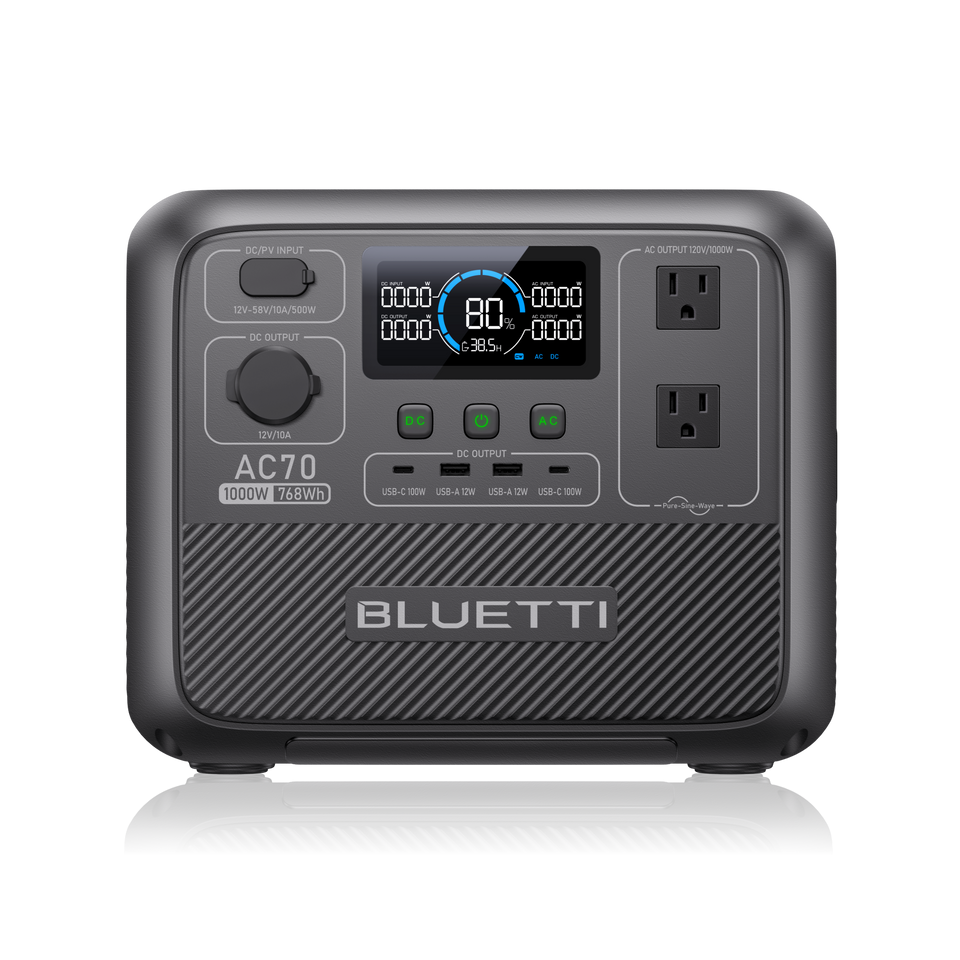
BLUETTI AC70
With 705–730.6 Wh of independently measured usable AC output from a 768Wh battery and 500W solar input at ~$399–$449 street price, the AC70 punches above typical 500Wh–700Wh units.
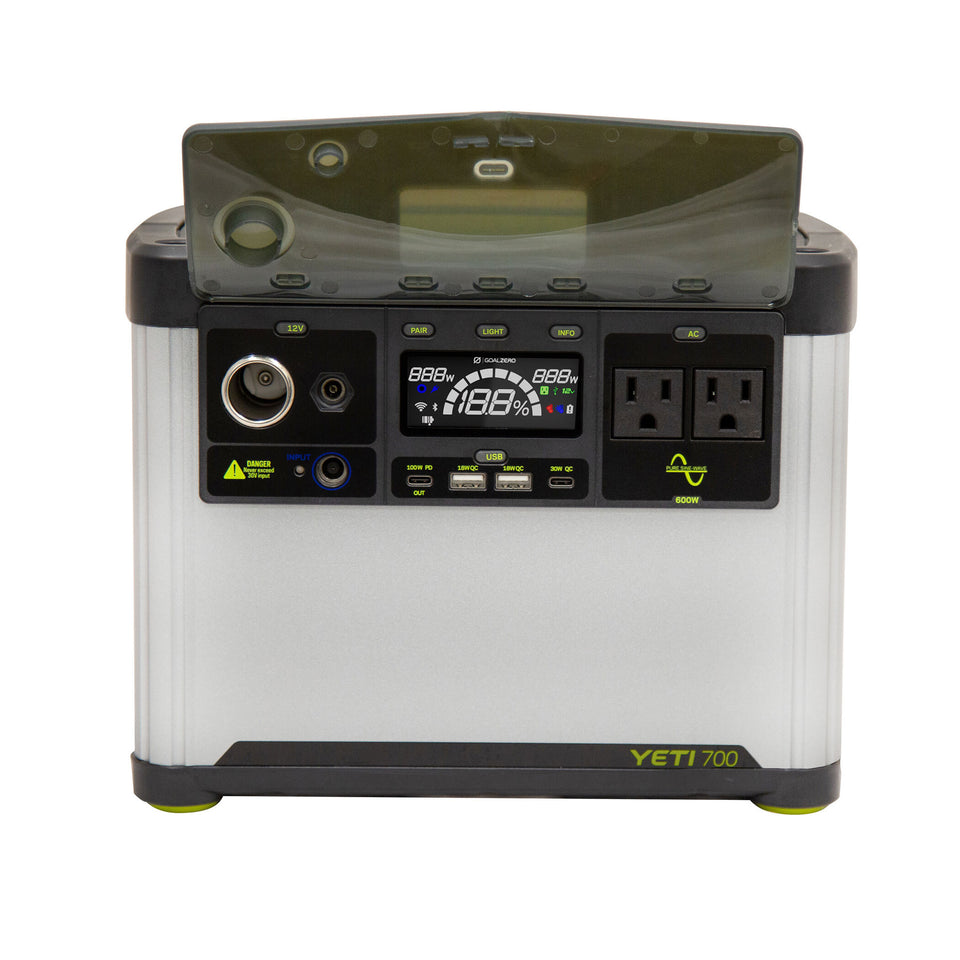
Goal Zero Yeti 700
Prioritizes IPX4 splash resistance, 4,000-cycle LFP longevity, and US-based warranty support over raw inverter wattage or solar charging speed.
Frequently Asked Questions
What is the difference between the Anker SOLIX C300 and the Anker SOLIX C300 DC?+
The Anker SOLIX C300 evaluated here (Model A1722) includes three 120V AC outlets powered by a 300W pure sine inverter alongside USB-C, USB-A, and a 12V car port. The cheaper C300 DC omits the AC inverter and AC wall outlets entirely, providing only USB and 12V DC ports.
Can the Anker SOLIX C300 run a household refrigerator or microwave?+
No. While its 288Wh battery could theoretically turn on an efficient mini-fridge briefly, a 300W continuous inverter and 288Wh capacity will deplete within roughly 1.5–2 hours on a standard refrigerator—and high compressor startup surges or 1,000W+ microwaves will trip overload protection.
How fast does the Anker SOLIX C300 switch over during a power outage?+
Anker rates the C300's automatic UPS switchover at under 10 ms—fast enough to keep home Wi-Fi routers, fiber ONT modems, and laptops running uninterrupted without dropping video calls.
Sources & Technical References
- View Source →[1]Manufacturer SpecificationAnker SOLIX US OfficialVerified 2026-11-24Anker SOLIX C300 Portable Power Station (Model A1722) Specifications
288Wh LFP AC-equipped model (distinct from DC-only C300 DC), 300W AC, 600W SurgePad, 100W XT60 solar, <10ms UPS.
- View Source →[2]Government Research ResourceNational Renewable Energy Laboratory (NREL)Verified 2026-11-24PVWatts & US Peak Sun Hours Reference Data
Documents regional peak sun hours and real-world photovoltaic derating factors (ambient heat, angle, shading, controller loss).
Model & Brand Comparisons
Related Sizing Guides & Tools
- How to Choose a Portable Power Station: Complete Sizing & Spec Guide →
- What Is UPS & EPS Switching in Portable Power Stations? (0ms vs <10ms vs 20ms) →
- Watt-Hours (Wh) vs. Watts (W) Explained: Capacity vs. Power Output →
- Battery Storage, Temperature & Safety Guide: Protecting LiFePO4 Longevity →
- Calculate custom runtime for Anker SOLIX C300 →