Watt-Hours (Wh) vs. Watts (W) Explained: Capacity vs. Power Output
Understand the crucial difference between battery capacity in Watt-hours (Wh) and inverter power output in Watts (W) so you never under-size your portable power station.
Watts (W) measure instantaneous power draw—determining which appliances can turn on without tripping inverter overload protection—while Watt-hours (Wh) measure total stored battery energy, determining how long devices run before recharging. A power station must satisfy both numbers simultaneously, accounting for real-world inverter losses.

Key Technical Takeaways
- Watts (W) measure instantaneous power flow—determining whether an appliance can turn on without tripping overload protection.
- Watt-hours (Wh) measure total stored energy—determining how long a device runs before the battery empties.
- A station with high Watts and modest Wh runs heavy appliances only briefly, while a high-Wh station with low Watts shuts off on heavy loads.
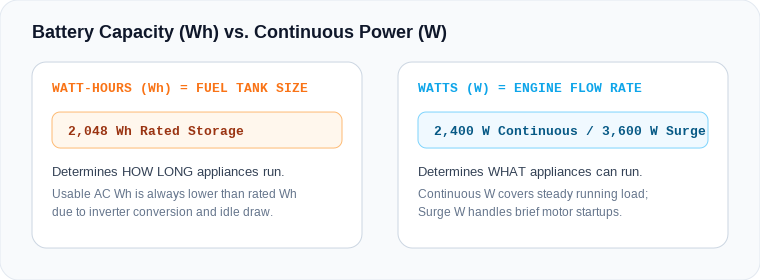
Confusing Watts (W) with Watt-hours (Wh) is the number-one mistake buyers make when shopping for portable power stations. Both terms appear side by side on every spec sheet, yet they measure completely different physical quantities—and getting either one wrong leads either to an immediate overload shutdown or a battery that dies hours earlier than expected.
The Core Difference: Rate vs. Reservoir
- Watts (W) = Power Flow Rate (What Can Run): Watts measure how fast energy is being delivered at a single instant. If your power station has a 1,000W continuous AC inverter and you plug in a 1,450W microwave, the inverter immediately detects an overload and shuts off—even if the battery is 100% full.
- Watt-hours (Wh) = Energy Capacity (How Long It Runs): Watt-hours measure the total energy stored inside the battery pack. One kilowatt-hour (1 kWh) equals 1,000 Wh. A 2,048Wh station holds roughly twice the stored energy of a 1,024Wh station, allowing identical loads to run roughly twice as long (accounting for inverter efficiency differences).
Why Real-World Models Balance Wh and W Differently
Manufacturers do not pair capacity and inverter wattage in a fixed 1:1 ratio. Looking at models in our verified US database illustrates why checking both numbers matters:
| Model | Capacity (Wh) | Continuous AC (W) | Real-World Implication |
|---|---|---|---|
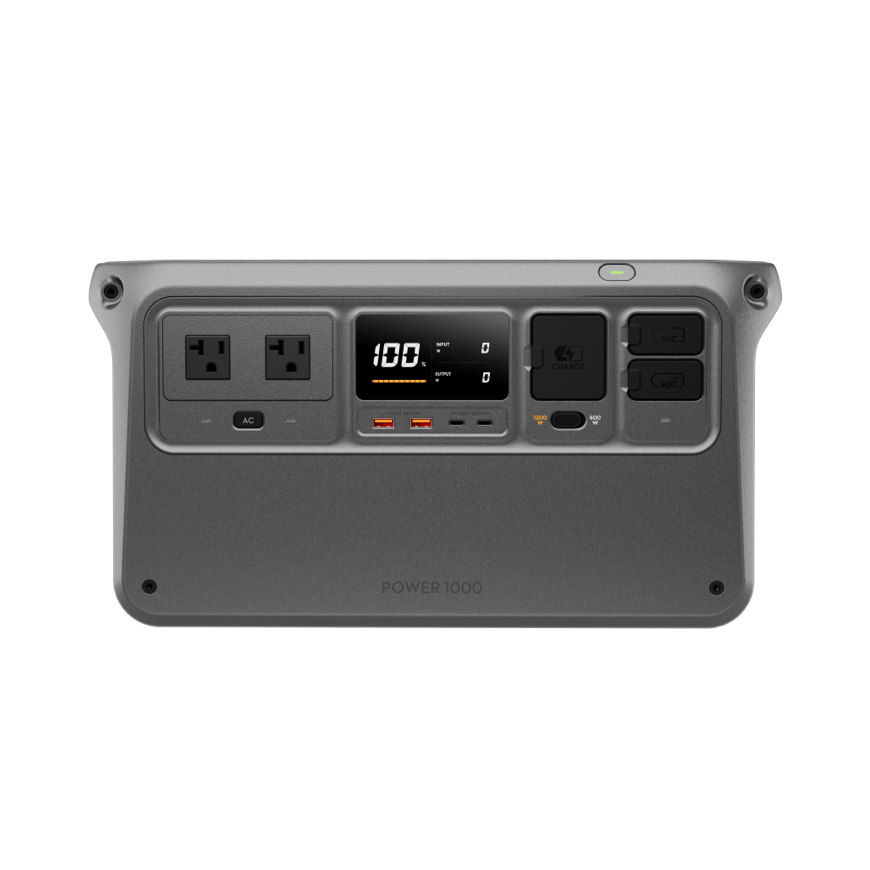
| DJI Power 1000 | 1,024 Wh | 2,200 W | High power-to-capacity ratio: easily powers a 1,500W kettle or microwave, but at 2,000W continuous load, the 1,024Wh pack empties in well under 30 minutes. |
| Goal Zero Yeti 700 | 677 Wh | 600 W | Built for endurance on light camp/12V loads (~45W–100W) for hours, but cannot start or run 1,000W+ cooking appliances. |
| BLUETTI AC200L | 2,048 Wh | 2,400 W | Balanced 2kWh/2.4kW midsize design: handles heavy kitchen or RV loads briefly while keeping enough energy for ~24+ hours of fridge duty. |
| EcoFlow DELTA Pro Ultra | 6,144 Wh | 7,200 W | High-capacity modular system built to run substantial 120V/240V circuits simultaneously across multi-hour or multi-day outages. |
How to Calculate Your Wattage and Watt-Hour Needs
1. Find Your Total Simultaneous Watts (W)
Check the electrical nameplate or sticker on every device you plan to run at the same time. If an appliance lists Amps (A) instead of Watts, multiply Volts × Amps = Watts (for standard US 120V outlets, 120V × 12A = 1,440W). Then check whether motor appliances have a higher startup surge, and enter them into our Appliance Wattage Calculator.
2. Calculate Daily Watt-Hours (Wh)
Multiply each device’s actual running wattage by the number of hours it runs per day—remembering duty cycles for cycling appliances:
- Continuous device (25W Wi-Fi router × 24 hrs):
600 Wh/day. - Intermittent device (150W refrigerator compressor running ~35%–45% of the day): Roughly
1,200–1,800 Wh/dayrather than150W × 24h = 3,600 Wh.
3. Apply Usable Energy Math—Not Nameplate Wh
Rated battery Wh is never equal to usable AC output because converting DC battery cells to 120V/240V AC consumes power inside the inverter and BMS. For example, on the 768Wh BLUETTI AC70, third-party tests measured 730.59 Wh usable AC output at 136W (APH Networks) and 705 Wh at 250W (PowerOffGrid). On unverified models, use a realistic 78%–88% AC usable range in our Battery Runtime Estimator—or switch low-wattage electronics to USB-C and 12V DC ports to bypass inverter losses.
Next, learn how motor startup spikes affect inverter sizing in Continuous Output vs. Surge Output and dive deeper into conversion math in Understanding Power Station Efficiency.
Frequently Asked Questions
What is the easiest analogy for Watts vs. Watt-hours?+
Think of Watt-hours (Wh) as the size of your car's fuel tank and Watts (W) as how wide open the fuel line or horsepower output is. A bigger tank lets you drive longer; a higher wattage inverter lets you pull heavier loads at the same moment.
How do I convert Amps and Volts on an appliance label into Watts?+
Multiply Volts by Amps (W = V × A). For example, a US 120V appliance rated at 10A draws roughly 1,200W under full load (for motors, inductive power factor and startup surge also apply).
Can a 2,000Wh power station run a 1,500W space heater all night?+
No. Accounting for conversion overhead (~78%–88% estimated AC usable output, or roughly 1,560–1,760 Wh usable), a 1,500W space heater running continuously on high will drain a 2,000Wh battery in roughly 1 to 1.2 hours.
Sources & Technical References
- View Source →[1]Manufacturer SpecificationDJI OfficialVerified 2026-11-24DJI Power 1000 Specifications & Official Overview
1,024Wh LFP, 2,200W continuous AC (V1 US model; V2 increases to 2,600W), dual 140W USB-C, 800W solar via MPPT adapter.
- View Source →[2]Manufacturer SpecificationBLUETTI US OfficialVerified 2026-11-24BLUETTI AC200L Portable Power Station Official Specifications
2,048Wh LFP, 2,400W continuous AC, 3,600W Power Lifting mode, NEMA TT-30R + 48V/8A DC RV port, 1,200W solar (12-145V).
- View Source →[3]Manufacturer SpecificationGoal Zero OfficialVerified 2026-11-24Goal Zero Yeti 700 Portable Power Station Specifications
677Wh LFP, 600W AC, 1,000W surge, 200W solar max, IPX4 weather-resistant chassis, 5-year warranty.
- View Source →[4]Manufacturer SpecificationEcoFlow US OfficialVerified 2026-11-24EcoFlow DELTA 3 Plus Official Specifications
1,024Wh LFP, 1,800W continuous AC, 1,000W dual 500W MPPT solar, <10ms UPS, 1,500W X-Stream AC charging.
- View Source →[5]Third-Party Independent ReviewAPH NetworksVerified 2026-11-24BLUETTI AC70 Portable Power Station Load Test Review
Constant 136W AC load discharge test measured 730.59 Wh usable output (~95% of rated 768Wh cell capacity; ~92.5% net inverter efficiency).