DJI Power 1000 Review (2026): 23 dB Acoustic Refinement & 2,200W Density (V1 vs V2)
DJI Power 1000 US review: 1,024Wh LFP, 2,200W AC, 23 dB acoustic rating, dual 140W USB-C, V1 vs V2 revision notes, and SDC solar adapter caveats.
The DJI Power 1000 V1 US model delivers an unusually strong 2,200W continuous pure-sine inverter, dual 140W USB-C PD 3.1 ports, and a whisper-quiet 23 dB rated standard-charging noise floor inside a 28.7 lb frame—frequently discounted around $549 on clearance. Its main compromises stem from DJI's accessory-first port design: solar input, 12V car sockets, and V1 Wi-Fi app monitoring require separate DJI SDC modules or dongles, while only two AC outlets limit multi-plug convenience.
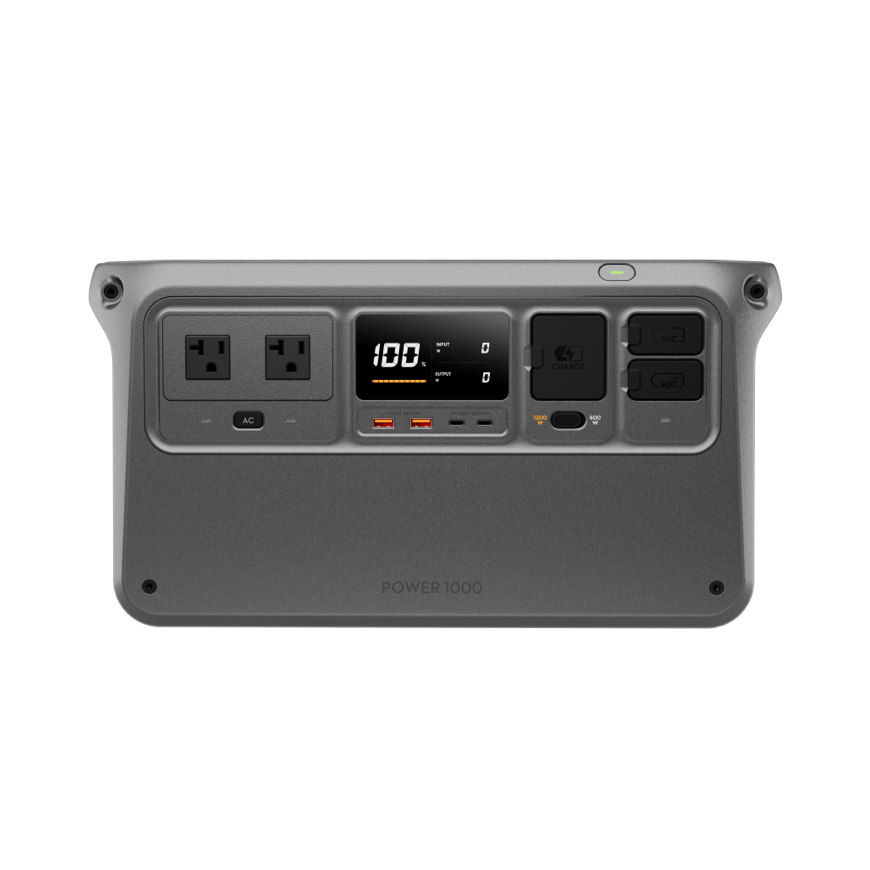
Launched at $999 MSRP; frequently discounted between $449 and $699 for V1 clearance/promotions ($0.54/rated Wh at street pricing).
Official Hardware & Application Gallery
Sourced from DJI Power official product media 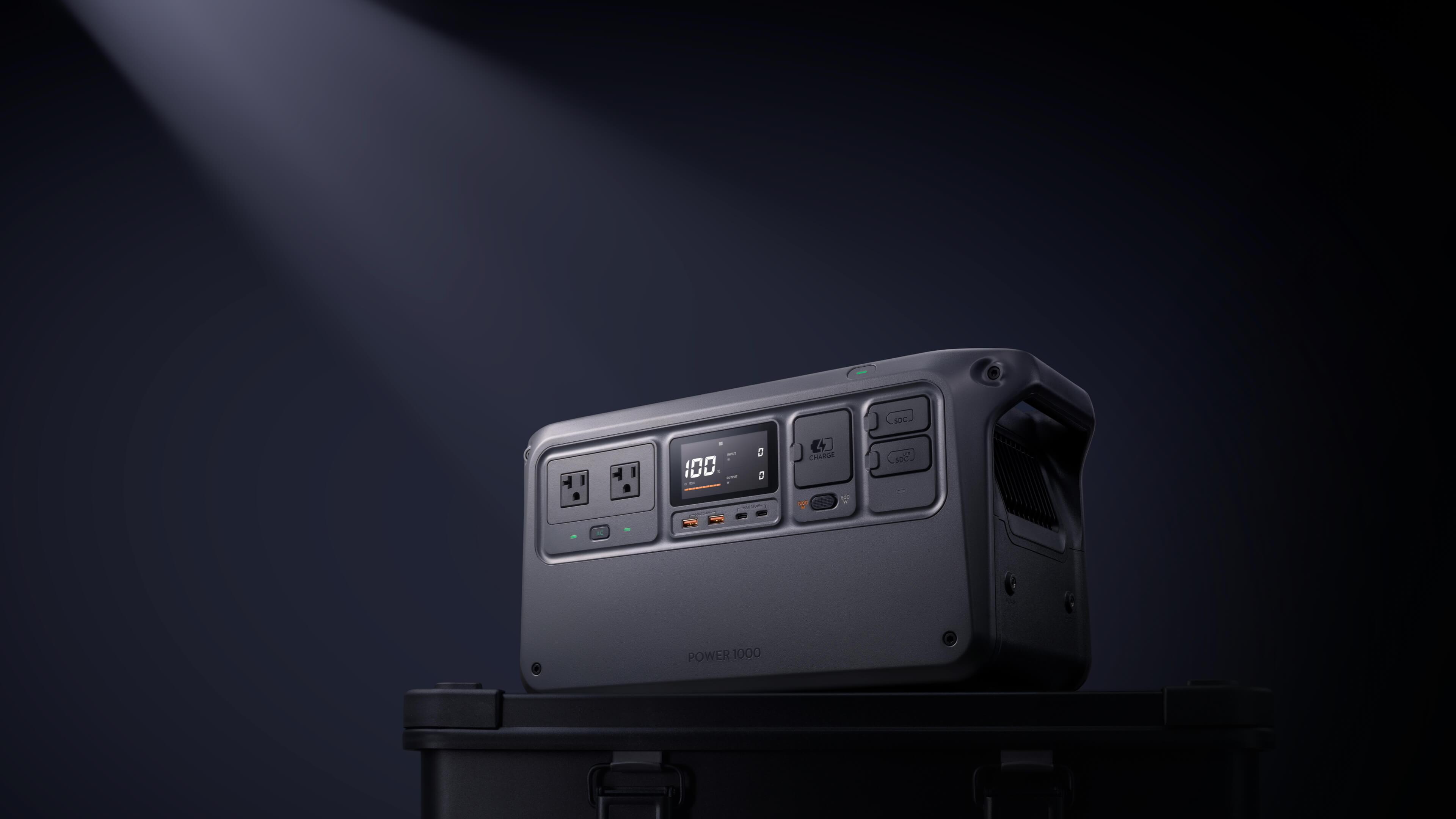
Key Advantages
- ✓2,200W continuous output beats most 1kWh rivals (typically capped at 1,800W)
- ✓Dual 140W USB-C PD 3.1 ports plus direct DJI drone battery SDC fast charging
- ✓Manufacturer-rated 23 dB acoustic floor during standard charging is ideal for sleepers and vans
Trade-offs & Limitations
- !No built-in XT60 solar input or 12V cigarette socket — requires purchasing DJI SDC adapter accessories
- !Only 2 standard 120V AC outlets
- !V1 model requires an optional dongle for Wi-Fi app monitoring
Ideal Applications
- Filmmakers, drone operators, and noise-sensitive van sleepers wanting 2,200W AC + 280W USB-C
- Shoppers catching discounted $449–$549 promotions for indoor backup power
Situations Where It May Not Fit
- Off-grid solar users expecting plug-and-play built-in MC4/XT60 solar ports without accessories
- Users needing 6+ simultaneous AC outlets or 12V car plugs natively
Complete Verified Specifications
| Specification | Verified Data | Data Provenance |
|---|---|---|
| Product Name & Revision | DJI Power 1000 (Power 1000 V1 US (note: Power 1000 V2 revision increases AC to 2,600W)) | Manufacturer Spec |
| US Market Version | US 120V Edition (Model DYM1000L) | Manufacturer Spec |
| Battery Capacity (Rated) | 1,024 Wh | Manufacturer Spec |
| Measured Usable AC Output | Not Independently Verified | Unverified |
| Battery Chemistry | LiFePO4 (LFP) | Manufacturer Spec |
| Published Cycle Life | 4,000 cycles to >=70% capacity — Manufacturer rating under standard 25°C lab cycling | Manufacturer Spec |
| Continuous AC Output | 2,200 W (Not Applicable (native 2,200W inverter; V2 raises output to 2,600W)) | Manufacturer Spec |
| Published Surge Output | 4,400 W | Manufacturer Spec |
| Published Surge Duration | Not Disclosed (short peak output rating) | Not Disclosed |
| AC Output Voltage | 120V | Manufacturer Spec |
| AC Outlet Types | 2 × 120V NEMA 5-20R standard AC outlets | Manufacturer Spec |
| USB-A Output | 2 × USB-A (24W max each) | Manufacturer Spec |
| USB-C Output | 2 × USB-C PD 3.1 (140W max each; 280W combined) | Manufacturer Spec |
| DC Output Ports | 2 × DJI SDC / SDC Lite expansion & drone fast-charge ports (no built-in 12V car socket without SDC cable) | Manufacturer Spec |
| Max Solar Input | 800 W | Manufacturer Spec |
| Solar Input Voltage Range (Voc) | Requires DJI Power Solar Panel Adapter Module (MPPT) via SDC port (supports up to ~400W per module / 800W max dual) | Manufacturer Spec |
| Solar Input Current Limit | Depends on DJI MPPT adapter module configuration | Manufacturer Spec |
| MPPT Configuration | External MPPT adapter architecture via SDC ports rather than built-in XT60 solar terminals | Manufacturer Spec |
| AC Charging Rate | 1,200 W max — Up to 1,200W fast charge (~70 mins 0–100%; 0–80% in ~50 mins) or 600W standard quiet mode | Manufacturer Spec |
| Car / Alternator Charging | Supports DJI 1kW Super Fast Car Charger or SDC car adapter accessories | Manufacturer Spec |
| Published Recharge Time | ~70 mins on 1,200W AC fast charge; ~1.5+ hrs via dual 400W solar MPPT adapters | Mfr / Attributed Test |
| Expandable Capacity | Yes — up to 11,264 Wh (Expandable via DJI Power Expansion Battery 2000 (2,048Wh) via SDC interface) | Manufacturer Spec |
| Supported Expansion Batteries | DJI Power Expansion Battery 2000 | Manufacturer Spec |
| UPS / EPS Functionality | Automatic EPS/UPS backup switching when grid input drops | Manufacturer Spec |
| Published Switching Time | <=20 ms (V1 rated <=20 ms; V2 rated ~10 ms) | Manufacturer Spec |
| Weight | 28.7 lbs (Approx. 13 kg (~28.7 lbs V1; ~31.3 lbs V2) without integrated wheels) | Manufacturer Spec |
| Dimensions (L × W × H) | 17.6 × 8.8 × 9.0 in | Manufacturer Spec |
| Operating Temp (Charging) | 32°F to 113°F (0°C to 45°C) | Manufacturer Spec |
| Operating Temp (Discharging) | 14°F to 113°F (-10°C to 45°C) | Manufacturer Spec |
| Noise Rating (Manufacturer) | As low as 23 dB during standard AC recharging (manufacturer rated) | Manufacturer Spec |
| App & Connectivity | Requires external DJI Power Dongle for app/Wi-Fi on V1 (Verify V1 vs V2 dongle inclusion) | Manufacturer Spec |
| Warranty & Verification Date | 5-Year Warranty (3-year standard + 2-year official registration) (Verified 2026-11-24) | Manufacturer Policy |
| Pricing & Value per Rated Wh | Typical Street ~$549 ($0.54/rated Wh) | MSRP $999 ($0.98/rated Wh) | Checked 2026-11-24 |
Evidence & Data Provenance Breakdown
SolarGeneratorWholeHouse separates official specifications, third-party measurements, owner patterns, and editorial estimates.
Capacity (1,024Wh LiFePO4 (LFP)), continuous AC (2,200W), surge (4,400W), solar voltage limits (Requires DJI Power Solar Panel Adapter Module (MPPT) via SDC port (supports up to ~400W per module / 800W max dual)), and warranty (5-Year Warranty (3-year standard + 2-year official registration)) are sourced directly from DJI Power documentation.
Not Independently Verified in Our Source Registry: Independent laboratory usable-AC-Wh discharge benchmarks for this exact US SKU are not yet recorded in our verified registry; runtime figures below use clearly labeled engineering estimates.
Noise (As low as 23 dB during standard AC recharging (manufacturer rated)) and cycle retention (4,000 cycles to >=70% capacity) reflect DJI Power's published ratings under manufacturer-specified test temperatures rather than independent long-term wear tests.
Reviewers and field creators praise the whisper-quiet fan acoustics and heavy 2,200W output, while consistently noting the extra budget needed for DJI's SDC solar and 12V adapter cables.
Unpublished fields: Surge duration (Not Disclosed (short peak output rating)).
Estimated AC Runtime Scenarios
| Sample Load | Estimated Runtime Range | Calculation Basis |
|---|---|---|
| Wi-Fi Router & Modem (~25W AC) | 31.9–36 hrs | Estimated 78%–88% usable AC range (untested model; accounts for inverter conversion & idle draw) |
| CPAP Machine (~45W AC avg) | 17.7–20 hrs | Estimated 78%–88% usable AC range (untested model; accounts for inverter conversion & idle draw) |
| Modern Refrigerator Avg Draw (~150W) | 5.3–6 hrs | Estimated 78%–88% usable AC range (untested model; accounts for inverter conversion & idle draw) |
| Home Office / Mixed Essential Load (~400W) | 2–2.3 hrs | Estimated 78%–88% usable AC range (untested model; accounts for inverter conversion & idle draw) |
| Portable AC / Heavy Load (~1,200W) | 0.7–0.8 hrs | Estimated 78%–88% usable AC range (untested model; accounts for inverter conversion & idle draw) |
Overview & US Market Positioning
When drone maker DJI entered the portable power market with the DJI Power 1000 (US 120V Edition, Model DYM1000L), it prioritized high inverter wattage density, ultra-low acoustic signatures, and rapid drone-battery charging rather than conventional all-in-one port layouts. Within a 28.7 lb rectangular frame holding 1,024Wh, DJI built a 2,200W continuous inverter—beating standard 1,800W 1kWh competitors like the EcoFlow DELTA 3 Plus by 400W of continuous headroom.
US buyers shopping in late 2026 must distinguish clearly between the Power 1000 V1 (Model DYM1000L) evaluated here and the Power 1000 V2 successor. While the V2 increases continuous AC to 2,600W, drops UPS switchover toward ~10 ms, and adds weight (~31.3 lbs), remaining V1 inventory routinely discounts to $449–$699 (averaging $549 street price). Compare how the V1 stacks up against EcoFlow’s flagship compact station in our EcoFlow DELTA 3 Plus vs. DJI Power 1000 comparison.
Battery Capacity, Chemistry & Cycle Longevity
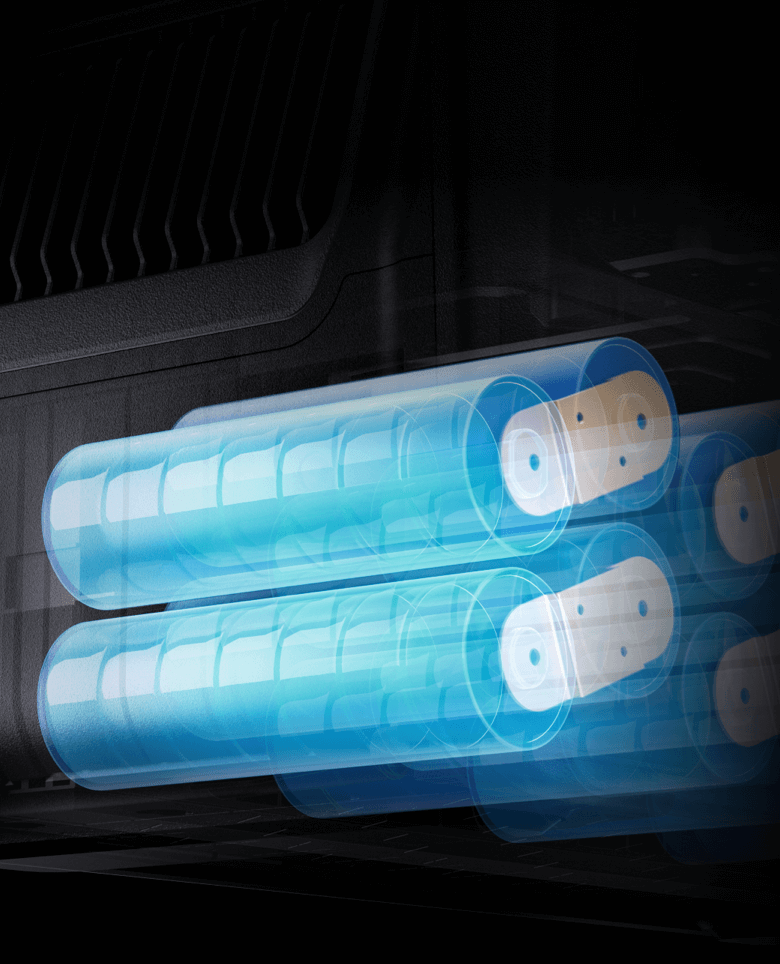
The Power 1000 contains 1,024Wh of LiFePO4 (LFP) battery storage rated by DJI for 4,000 cycles to >=70% capacity under standard 25°C lab cycling. Just like Jackery’s 4,000-cycle rating, keep in mind that DJI uses a 70% remaining capacity threshold rather than the 80% end-of-life benchmark cited by EcoFlow and BLUETTI. Even accounting for that difference, 4,000 LFP cycles spans well over a decade of regular field production or home outage use.
Operating temperatures span 32°F to 113°F (0°C to 45°C) for charging and 14°F to 113°F (-10°C to 45°C) for discharging. There is no below-freezing self-heating system, and cold-weather discharge stops at 14°F (-10°C)—matching EcoFlow DELTA 3 Plus but stopping 18°F warmer than BLUETTI AC70’s -4°F discharge floor.
Continuous AC Output, Surge Behavior & Voltage Support
For a 1kWh-class unit, 2,200W continuous 120V AC output with 4,400W peak surge (exact published surge duration is Not Disclosed) is remarkable—matching the continuous output of the 2,042Wh Jackery Explorer 2000 v2 and outpowering 1,800W compact rivals without resorting to voltage-lowering boost modes. That extra 400W gives filmmakers, tailgaters, and homeowners running 1,500W–1,800W microwaves, heat guns, induction plates, or heavy camera studio strobes cleaner AC margin.
Port distribution, however, reveals DJI’s specialized priorities:
- 2 × 120V NEMA 5-20R AC outlets (limiting simultaneous plug-ins compared with EcoFlow’s six AC outlets)
- 2 × USB-C PD 3.1 (140W max each; 280W combined) + 2 × 24W USB-A ports
- 2 × DJI SDC / SDC Lite high-speed expansion and drone fast-charge ports
- No built-in 12V car socket or panel-mounted XT60 solar terminal without optional SDC adapter accessories
If you power laptops, cinema cameras, and DJI Mavic/Inspire/Matrice flight batteries via SDC fast cables, the Power 1000 feels purpose-built. If you want a plug-and-play 12V cooler socket and six AC plugs out of the box, plan ahead for accessory cables or consider the EcoFlow DELTA 3 Plus.
Solar Charging, AC Charging & Expansion Ecosystem
Unlike virtually every competitor in our catalog, the Power 1000 V1 omits built-in solar MPPT terminals from the main body. To charge from solar panels—up to 800W combined—buyers must purchase one or two external DJI Power Solar Panel Adapter Modules (MPPT) (~400W max per module) that attach via the SDC ports. That external-module architecture keeps the core chassis sleek and affordable at clearance pricing, yet adds extra cost, cable clutter, and voltage-matching homework before connecting standard third-party panels. Always confirm the exact Voc/current rating of the DJI MPPT adapter module prior to pairing arrays, and model sunlight recovery in our Solar Charging Time Estimator.
Grid charging is simple and fast: 1,200W fast AC mode refills 0–80% in roughly 50 minutes and reaches 100% in ~70 minutes, while a 600W standard mode trades speed for ultra-quiet operation. Vehicle recharging uses DJI’s optional 1kW Super Fast Car Charger or SDC car adapters. Storage scales surprisingly high for a 1kWh unit: daisy-chaining DJI Power Expansion Battery 2000 (2,048Wh) packs via the SDC bus extends total system capacity up to 11,264Wh.
UPS/EPS Behavior, Cooling Noise & App Features
Acoustic refinement is the DJI Power 1000’s headline engineering feat. DJI rates fan noise as low as 23 dB during standard 600W AC recharging—quieter than a whispered library and substantially calmer than typical 30+ dB power stations, making it exceptionally pleasant beside a camper van bed or inside a quiet editing studio (full-load 2,200W inverter dB figures are Not Disclosed and unverified in our lab registry).
Automatic EPS/UPS pass-through backup is rated at <=20 ms on the V1 (whereas the newer V2 improves toward ~10 ms). That handles home routers, studio lights, and everyday electronics reliably, though critical workstations or NAS appliances wanting sub-10 ms HID USB signaling are better paired with the EcoFlow DELTA 3 Plus. Finally, note that V1 units require an optional external DJI Power Dongle to unlock Wi-Fi smartphone app telemetry (check V1 vs. V2 bundle terms carefully).
Runtime Considerations & Real-World Performance Data
Independent third-party laboratory usable AC watt-hour tests and standardized round-trip efficiency measurements for the DJI Power 1000 are Not Independently Verified in our source registry. Using our standard 78% to 88% AC conversion estimation range across the 1,024Wh battery (799Wh to 901Wh estimated usable AC output):
- Wi-Fi Router & Modem (~25W AC): Approx. 32.0 to 36.0 hours.
- CPAP Machine (~45W AC): Approx. 17.8 to 20.0 hours.
- Modern Refrigerator (~150W avg): Approx. 5.3 to 6.0 hours steady draw (longer during cyclic compressor idling, though overnight+ outages require expansion or solar).
- Home Office / Mixed Production Load (~400W): Approx. 2.0 to 2.3 hours.
- High-Draw Load (~1,200W): Approx. 0.7 to 0.8 hours (~40–45 minutes, enabled smoothly by the 2,200W inverter).
Estimate bespoke field-production or emergency scenarios in our Battery Runtime Estimator.
Build Quality, Portability & Dimensions
Measuring 17.6 × 8.8 × 9.0 inches and weighing 28.7 lbs (~13 kg), the Power 1000 sports a low, ruggedized matte chassis with dual end carry handles and sturdy top structural protection built to withstand field transport in camera vans and SUV cargo boxes. Notice it is slightly longer and 1.1 lbs heavier than the EcoFlow DELTA 3 Plus, without wheels.
Advantages, Disadvantages & Ideal Applications
Key Advantages
- Class-leading 2,200W continuous / 4,400W surge inverter in a compact 1,024Wh chassis.
- Exceptional 23 dB manufacturer-rated acoustic floor during standard charging—outstanding for sleepers and video production sets.
- Dual 140W USB-C PD 3.1 (280W combined) plus direct SDC DJI drone fast-charging and up to 11.2kWh expansion capability.
Trade-offs & Limitations
- No built-in solar XT60 terminal or 12V car socket—requires buying separate DJI SDC adapter modules and cables.
- Only 2 standard 120V AC outlets, and V1 models need an optional DJI Power Dongle for Wi-Fi app control.
- Usable AC Wh efficiency and surge duration remain Not Independently Verified / Not Disclosed.
Ideal Applications: Drone pilots, field filmmakers, van sleepers sensitive to cooling fan noise, and bargain hunters catching V1 promotional pricing ($449–$549) for quiet 2,200W indoor outage backup.
Price, Value per Rated Wh & Warranty
Although the DJI Power 1000 launched at $999 MSRP ($0.98/rated Wh), ongoing V1 clearance and retail promotions between $449 and $699—centering around $549 typical street price—push cost down to an aggressive $0.54 per rated Wh ($0.44/Wh at $449). Keep an honest total-cost tally: adding a solar MPPT adapter, 12V car cable, or Wi-Fi dongle adds noticeably to the base price if you need those features. Cost per measured usable AC Wh is Not Independently Verified. DJI backs US units with a 5-Year Warranty (3-year standard plus 2-year official registration extension).
Close Alternatives to Consider

EcoFlow DELTA 3 Plus
Packs 1,000W dual-MPPT solar charging, sub-1-hour AC replenishment, and a sub-10 ms HID-capable UPS into a 27.6 lb chassis, making it more versatile than non-Plus 1kWh units.

Pecron E1500LFP
Delivers 1,536Wh, a 2,200W continuous inverter, and a rare 12V/30A XT60 DC port around $599 street price, though its asymmetric 32–95V GX16MF solar input requires careful panel voltage matching.
Frequently Asked Questions
What is the difference between the DJI Power 1000 V1 and the newer Power 1000 V2?+
The original Power 1000 V1 (US Model DYM1000L) reviewed here delivers 2,200W continuous AC output, <=20 ms UPS switching, and weighs 28.7 lbs, requiring an external DJI Power Dongle for Wi-Fi app access. The newer V2 revision raises continuous AC output to 2,600W, tightens UPS switching to ~10 ms, and weighs ~31.3 lbs—verify exact SKU specs and dongle inclusion before ordering.
Can I plug standard solar panels directly into the DJI Power 1000?+
Not out of the box without accessories. Unlike EcoFlow or BLUETTI units with built-in XT60 or solar terminals, the DJI Power 1000 uses proprietary SDC ports and requires purchasing one or two external DJI Power Solar Panel Adapter Modules (MPPT) to accept solar input up to 800W combined.
Does the DJI Power 1000 have a built-in 12V cigarette lighter car socket?+
No. Like solar charging, 12V car output requires an optional DJI SDC-to-Car-Outlet cable accessory rather than a panel-mounted 12V port.
Sources & Technical References
- View Source →[1]Manufacturer SpecificationDJI OfficialVerified 2026-11-24DJI Power 1000 Specifications & Official Overview
1,024Wh LFP, 2,200W continuous AC (V1 US model; V2 increases to 2,600W), dual 140W USB-C, 800W solar via MPPT adapter.
- View Source →[2]Government Research ResourceNational Renewable Energy Laboratory (NREL)Verified 2026-11-24PVWatts & US Peak Sun Hours Reference Data
Documents regional peak sun hours and real-world photovoltaic derating factors (ambient heat, angle, shading, controller loss).
Model & Brand Comparisons
Related Sizing Guides & Tools
- What Is UPS & EPS Switching in Portable Power Stations? (0ms vs <10ms vs 20ms) →
- Watt-Hours (Wh) vs. Watts (W) Explained: Capacity vs. Power Output →
- Solar Input Limits & MPPT Explained: Voc Ceilings, Cold Weather & Panel Sizing →
- Understanding Power Station Efficiency: Why Rated Wh Never Equals Usable AC Energy →
- Calculate custom runtime for DJI Power 1000 →