Why Rated Watt-Hours Never Equal Usable AC Energy (And How to Estimate Real Runtime)
Why a 1,000Wh or 3,840Wh portable power station delivers less AC output than its nameplate capacity, using attributed third-party tests and transparent estimation ranges.
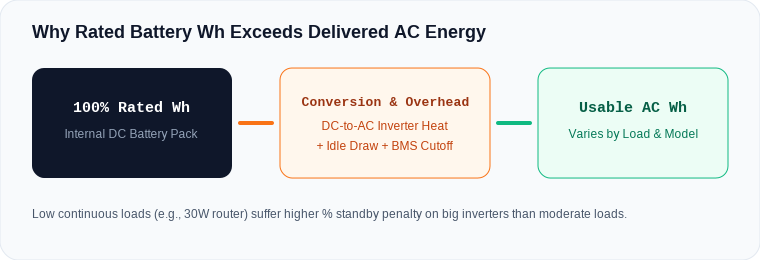
Advertised Watt-hours measure internal DC battery storage, not energy delivered at the AC wall outlets. DC-to-AC inverter heat, continuous standby idle draw, cooling fans, and protective BMS reserves typically leave roughly 78%–88% usable AC energy on midsize stations under moderate loads—or substantially less when huge 240V inverters run tiny light loads.
Every shopper has done the quick mental division on a product page: “If this unit holds 1,024 Wh and my appliance uses 100 W, it should run for 10.24 hours.” Yet once the blackout hits, real-world AC runtime almost always falls 10% to 30% short of that back-of-the-envelope calculation.
Understanding why rated DC Wh never equals usable AC energy prevents sizing mistakes—and exposes why throwing a giant 240V inverter at a small 120V load can actually shorten runtime.
What Independent Third-Party Benchmarks Measure
Because SolarGeneratorWholeHouse does not operate an internal test lab, we distinguish between manufacturer specs, attributed third-party tests, and engineering estimates. Look at what independent reviewers recorded across our verified source registry:
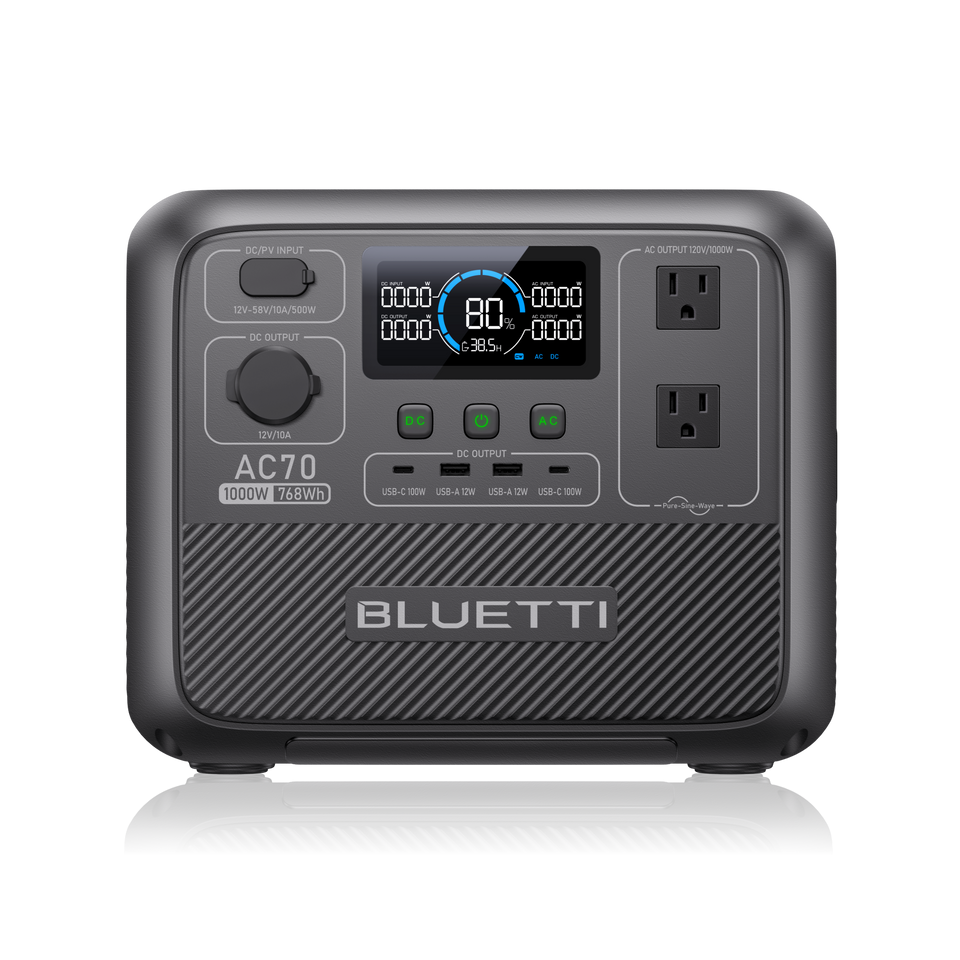
- BLUETTI AC70 (768 Wh Rated Pack):
- APH Networks measured 730.59 Wh usable AC output during a constant 136W AC load test (~95% of rated capacity; ~92.5% net inverter efficiency).
- PowerOffGrid measured 705 Wh usable AC output during a constant 250W resistive load (~91.8% of rated Wh / ~90% overall system efficiency).
- BLUETTI AC200L vs. Anker SOLIX F3800 (CNET Labs):
- CNET Labs documented 77.76% round-trip efficiency and >29 hours on a standardized refrigerator test for the 2,048Wh BLUETTI AC200L.
- On the same standardized refrigerator stress test, the 3,840Wh Anker SOLIX F3800 lasted roughly 25.68 hours—demonstrating how heavy dual-voltage 6,000W inverter overhead eats into battery reserves over long, low-duty-cycle runs.
Verification Note: For models in our database without attributed third-party discharge benchmarks in our source registry (such as the EcoFlow DELTA 3 Plus or Jackery Explorer 5000 Plus), we explicitly label usable AC energy as Not Independently Verified and apply a transparent 78%–88% AC range (or 72%–84% for light loads on 3,800W+ 240V units) in our Battery Runtime Estimator.
Why a Single “85% Efficiency Rule” Fails Buyers
Many generic blogs advise multiplying every station’s capacity by 0.85. That shortcut breaks down in two opposite directions:
- Moderate Steady Loads on Compact Inverters Can Exceed 85%: As APH Networks and PowerOffGrid proved on the BLUETTI AC70, running 136W–250W steadily on a well-tuned 1,000W inverter can yield 90%–92.5% of rated battery capacity.
- Tiny Intermittent Loads on Massive Inverters Drop Well Below 75%: Suppose a large split-phase inverter draws ~45W internally just to remain switched on. Over a 24-hour refrigerator outage,
45W × 24 hours = 1,080 Whvanishes solely into inverter standby overhead—before counting compressor power or conversion heat!
AC vs. DC Efficiency: The Hidden Shortcut
Whenever you power laptops, routers, LED strips, or approved medical DC rigs directly through USB-C PD or 12V DC outputs with the AC inverter switched OFF, you eliminate DC-to-AC boost conversion and large inverter standby overhead—typically retaining an estimated 88%–93% of rated pack capacity.
Before purchasing, compare both advertised $/rated Wh and measured $/usable AC Wh in our Price per Wh Calculator, and dive into the full breakdown in Understanding Power Station Efficiency.
Models Discussed in This Article
BLUETTI AC70
With 705–730.6 Wh of independently measured usable AC output from a 768Wh battery and 500W solar input at ~$399–$449 street price, the AC70 punches above typical 500Wh–700Wh units.

BLUETTI AC200L
Combines a high-efficiency 2,048Wh expandable platform, 1,200W high-voltage solar input (12–145V), and dedicated 30A TT-30R + 48V DC RV outputs at strong street pricing, trading away light weight and built-in wheels.

Anker SOLIX F3800
One of the most approachable plug-and-play 120V/240V wheeled units thanks to built-in NEMA 14-50R and L14-30R ports, though high idle overhead on light loads and the 60V solar cap (on the original non-Plus SKU) require careful sizing.

EcoFlow DELTA 3 Plus
Packs 1,000W dual-MPPT solar charging, sub-1-hour AC replenishment, and a sub-10 ms HID-capable UPS into a 27.6 lb chassis, making it more versatile than non-Plus 1kWh units.
Frequently Asked Questions
Are portable power station brands lying about their Watt-hour ratings?+
No—nameplate Watt-hours measure the raw energy stored in the DC lithium cells (cell voltage × amp-hours), which is industry standard. What marketing pages often omit is how much energy disappears converting DC battery voltage into 120V/240V AC power and keeping the inverter alive.
Why did a 2,048Wh BLUETTI AC200L outlast a 3,840Wh Anker F3800 in CNET's refrigerator test?+
According to CNET Labs' standardized refrigerator test, the BLUETTI AC200L ran over 29 hours with 77.76% round-trip efficiency, while the much larger 3,840Wh Anker SOLIX F3800 ran roughly 25.68 hours. A 6,000W 120V/240V split-phase inverter draws significantly more continuous standby idle power over 24+ hours of intermittent fridge duty than a compact 120V-only inverter.
Sources & Technical References
- View Source →[1]Third-Party Independent ReviewAPH NetworksVerified 2026-11-24BLUETTI AC70 Portable Power Station Load Test Review
Constant 136W AC load discharge test measured 730.59 Wh usable output (~95% of rated 768Wh cell capacity; ~92.5% net inverter efficiency).
- View Source →[2]Third-Party Independent ReviewPowerOffGridVerified 2026-11-24BLUETTI AC70 Usable AC Capacity & Inverter Efficiency Test
250W continuous resistive load AC discharge test recorded 705 Wh usable AC output (~90% overall system efficiency).
- View Source →[3]Third-Party Independent ReviewCNETVerified 2026-11-24CNET Portable Power Station Lab Efficiency & Refrigerator Runtime Benchmarks
Documents standardized refrigerator runtime and round-trip efficiency testing including BLUETTI AC200L (77.76% RTE, >29h fridge test) and Anker SOLIX F3800 (~25.68h fridge stress runtime due to dual-voltage inverter overhead).
- View Source →[4]Manufacturer SpecificationBLUETTI US OfficialVerified 2026-11-24BLUETTI AC70 Portable Power Station Official Specifications
768Wh LFP, 1,000W continuous AC, 2,000W Power Lifting resistive mode, 500W MPPT solar (12-58V, 10A), 950W Turbo AC charge.
- View Source →[5]Manufacturer SpecificationBLUETTI US OfficialVerified 2026-11-24BLUETTI AC200L Portable Power Station Official Specifications
2,048Wh LFP, 2,400W continuous AC, 3,600W Power Lifting mode, NEMA TT-30R + 48V/8A DC RV port, 1,200W solar (12-145V).
- View Source →[6]Manufacturer SpecificationAnker SOLIX US OfficialVerified 2026-11-24Anker SOLIX F3800 Portable Power Station Official Specifications
North American model specs including NEMA 14-50R, L14-30R, 6,000W output, 3,840Wh capacity, and 11-60V dual solar input.